When does a fintech need its own chain on Ethereum? (and how Aligned's RaaS helps them)
Launching on Ethereum L1 is the right first move for most fintech companies. Four signals tell you when your own chain has become necessary, and when the moment arrives, the rollup you choose matters.
TL;DR
- Launching on Ethereum L1 is the right first move for most fintech companies.
- Four signals tell you when your own chain has become necessary: fee variance at high throughput, permissioning requirements, the need to customize what you offer your users, and volume that makes dedicated capacity cheaper than paying for blockspace on L1.
- When the moment arrives, the rollup you choose matters. Not all rollups are built the same way.
Ethereum L1 works at the start. The liquidity is there, the developer tools exist, and the infrastructure is already built. For validating product-market fit, it is the right choice. But it is not the destination.
On Ethereum L1, the rules belong to the protocol, and so does everything that follows from them: who uses the same blockspace, what fees look like, how your users experience the product end to end. That is barely noticeable while the product is small, and very noticeable when it scales.
The fintech companies moving the most volume on Ethereum share a pattern: they eventually run their own chain, not at launch, but once the cost of not having control shows up in their margins, their compliance posture, and their product roadmap.
Most teams know they will eventually need their own chain. The harder question is knowing when.
Four signals
01) Margin: Gas on Ethereum L1 is a market. When demand for blockspace spikes, the clearing price rises for everyone, including you, and a spike in activity that has nothing to do with your product moves your fees. A product with high throughput feels that variance on every transaction. When the fee you pay for L1 blockspace becomes a line item that moves your unit economics, you are paying rent on infrastructure you could own.
02) Permissioning: Many financial products need control over who participates in their ecosystem, and they need it to be seamless for the user. Ethereum L1 is permissionless by design. That is its strength and, for these use cases, your constraint. You can enforce some rules contract by contract. What you cannot do at the application layer is make them the default for everything on the chain, or decide who else shares the network with you. On your own chain, the rules for permissioned transactions can be embedded directly in the sequencer: who transacts, which assets move, and under what conditions, enforced by the chain itself rather than bolted onto each contract.
03) Customizability: As the product matures, you need more control over the features you offer your users. On Ethereum L1 those are protocol decisions, and they are made for the whole network. On your own chain, they are product decisions, and you make them.
04) Volume: When your daily transactions are large enough that dedicated capacity costs less than what you pay for L1 blockspace, the math has already made the decision. At scale, every transaction on L1 competes with everyone else's. On your own chain, you control the fee structure and keep it predictable.
What owning a chain gives you
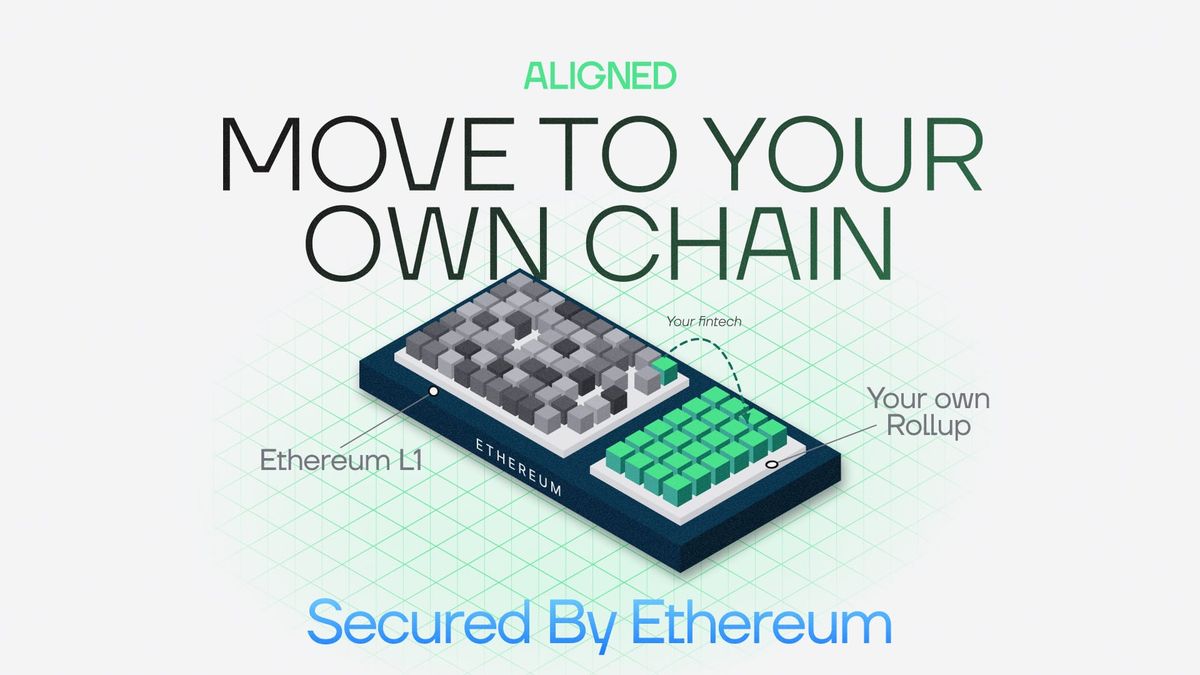
Owning a chain gives you predictable costs, your own permissioning rules, features designed for your product, and the user relationship without anyone else's roadmap in the middle.
What it does not give you automatically is a chain you can trust in production. Most rollup providers solve the scalability problem and hand you a stack you cannot read, a prover you cannot swap, and a settlement path you have to take on faith. For a regulated financial product, each of those is a dependency you are handing to your infrastructure provider.
This is where the architecture of the rollup you choose matters as much as having one.
Why Aligned's Rollup-as-a-Service is different
Time to having your own chain live is short: deployment is one click. Three design decisions make a difference in production:
The codebase. Aligned's chains are built with ethrex, the most performant Ethereum execution client, written in Rust by LambdaClass, at around 62,000 lines of code. Other execution clients typically exceed 200,000 lines, and often 500,000 with their dependencies. A smaller codebase means fewer bugs, faster security audits, and infrastructure your team can read. ethrex is open source and runs as both an L1 client and a fully EVM-compatible L2. It passes the Ethereum Foundation's full Hive conformance suite and runs public testnets for upcoming proposals like EIP-8141 frame transactions.
The proving system. A provider that locks you into a single prover creates a dependency you will feel the day that system slows down or a security finding surfaces. ethrex supports SP1, ZisK and TEEs out of the box, with an integration for OpenVM, so your stack is not hostage to a single team's roadmap. Once it is production ready, ethrex will add support for LambdaVM, Aligned's zkVM built in partnership with LambdaClass and 3MI Labs.
The settlement path. ethrex L2 already supports Aligned's Proof Aggregation Service. Your chain's proofs are aggregated with others before they reach Ethereum, so settlement cost is shared instead of paid in full by every chain on its own.
Live today
Aligned's Rollup-as-a-Service is in production with selected partners, with the Proof Aggregation Service already integrated for settlement on Ethereum. Sovra, which runs government digital identity infrastructure for 6M+ users in Latin America, is the first partner we serve publicly: a regulated, permissioned, customized chain built on this architecture.
If a rollup is on your roadmap, reach out. We will help you evaluate whether a dedicated chain is right for your product, and if it is, we will design the stack with you.