Propia: the public trust layer for verifiable credentials
Today we're introducing Propia, a public protocol for verifiable digital credentials, built through a collaboration between Sovra, Lambda, and Aligned. Read the full whitepaper for technical coverage.
Propia starts from a premise that sounds obvious until you look at how institutions actually work: trust established by one institution should be reusable by others. When a government verifies who you are, a university should be able to build on that instead of asking for the same documents again. Afterwards, a bank should be able to build on both.
That doesn't happen today. Propia is the missing piece that makes it possible, and it settles on Ethereum.
The problem is duplicated verification
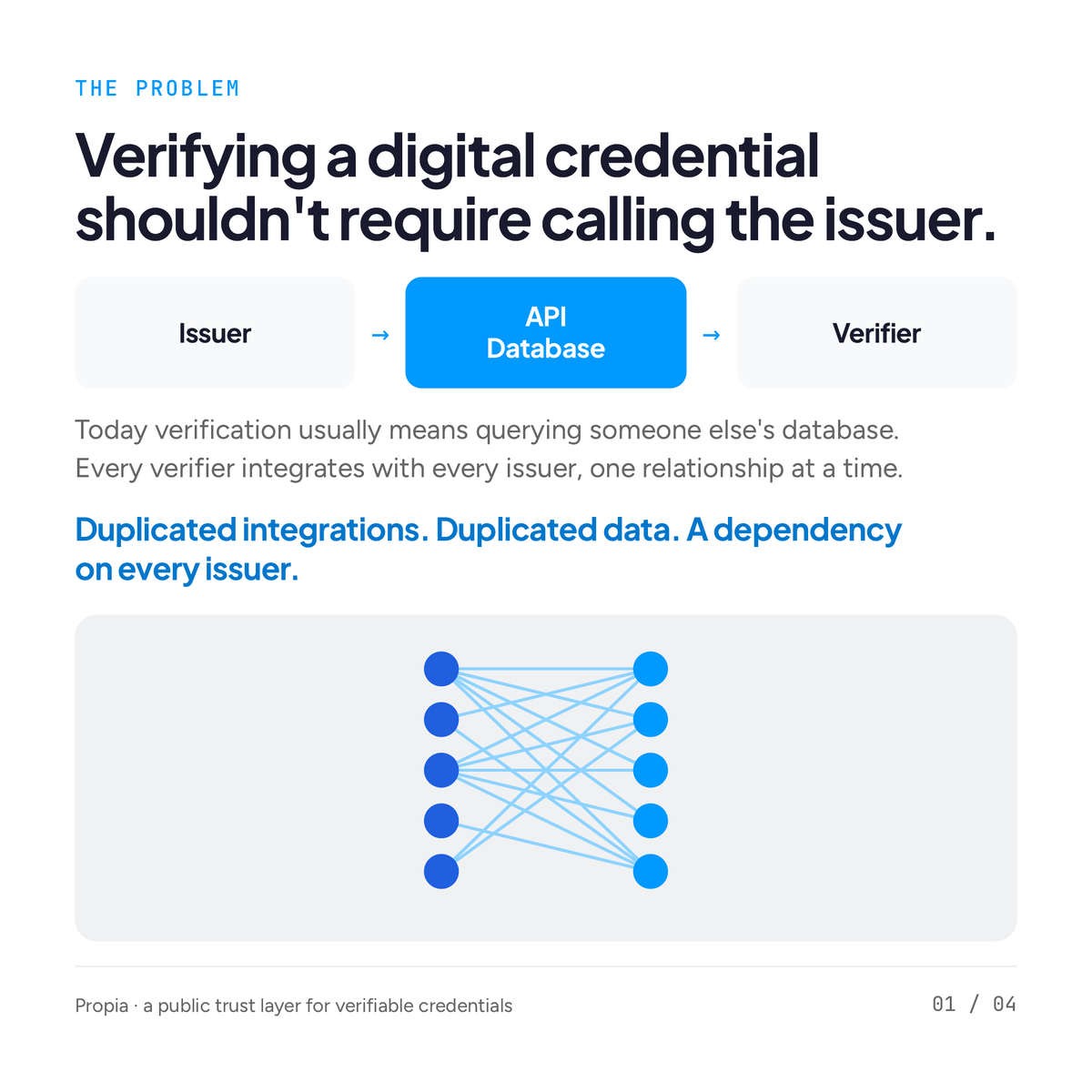
Most institutional processes start from zero. You submit similar evidence to a university, a bank, an employer, and a public agency. Each one runs its own checks, builds its own integrations, and often stores another copy of the same personal data. Every copy is cost, and every one of them is a breach exposure.
Generative AI has made this worse in a specific way. Document forgery used to require equipment, access, and skill. Now images, voices, signatures, and identity documents can look authentic with no reliable connection to their purported source. Verification that depends on a human looking at a document is losing its foundation.
The answer is credentials that are verifiable by cryptography rather than by inspection. Open standards already define how to issue and present them: W3C, ISO, IETF, and OpenID have done that work.
But portability alone doesn't create trust. A valid signature proves that some key signed something. It doesn't tell a verifier whether that key was ever authorized to issue a driver's licence, whether the issuer's keys have rotated since, or whether the credential was revoked last week.
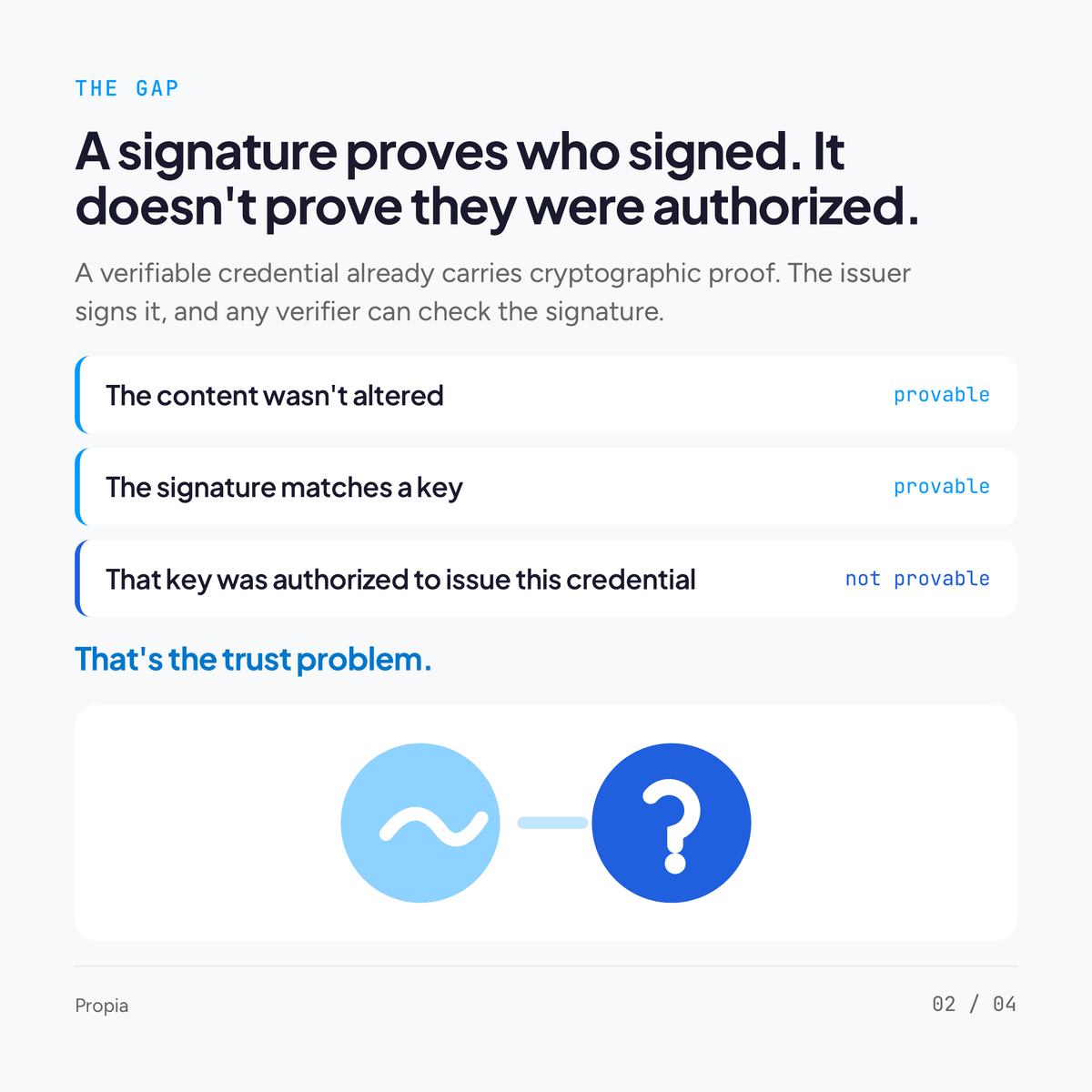
That's the gap Propia fills.
What Propia actually is
Propia is a set of three public trust registries:
- Issuer registry: which institutions are authorized to issue which credential types, under which trust framework, in which jurisdiction. Authorization is scoped: a transport authority can be authorized for driver's licences without being authorized for university degrees.
- Identifier registry: which keys currently control an identifier, and the rules under which that control can change. Key rotation and recovery become explicit, governed state transitions rather than support tickets.
- Status registry: compact suspension and revocation state, published by the issuer responsible for each credential.
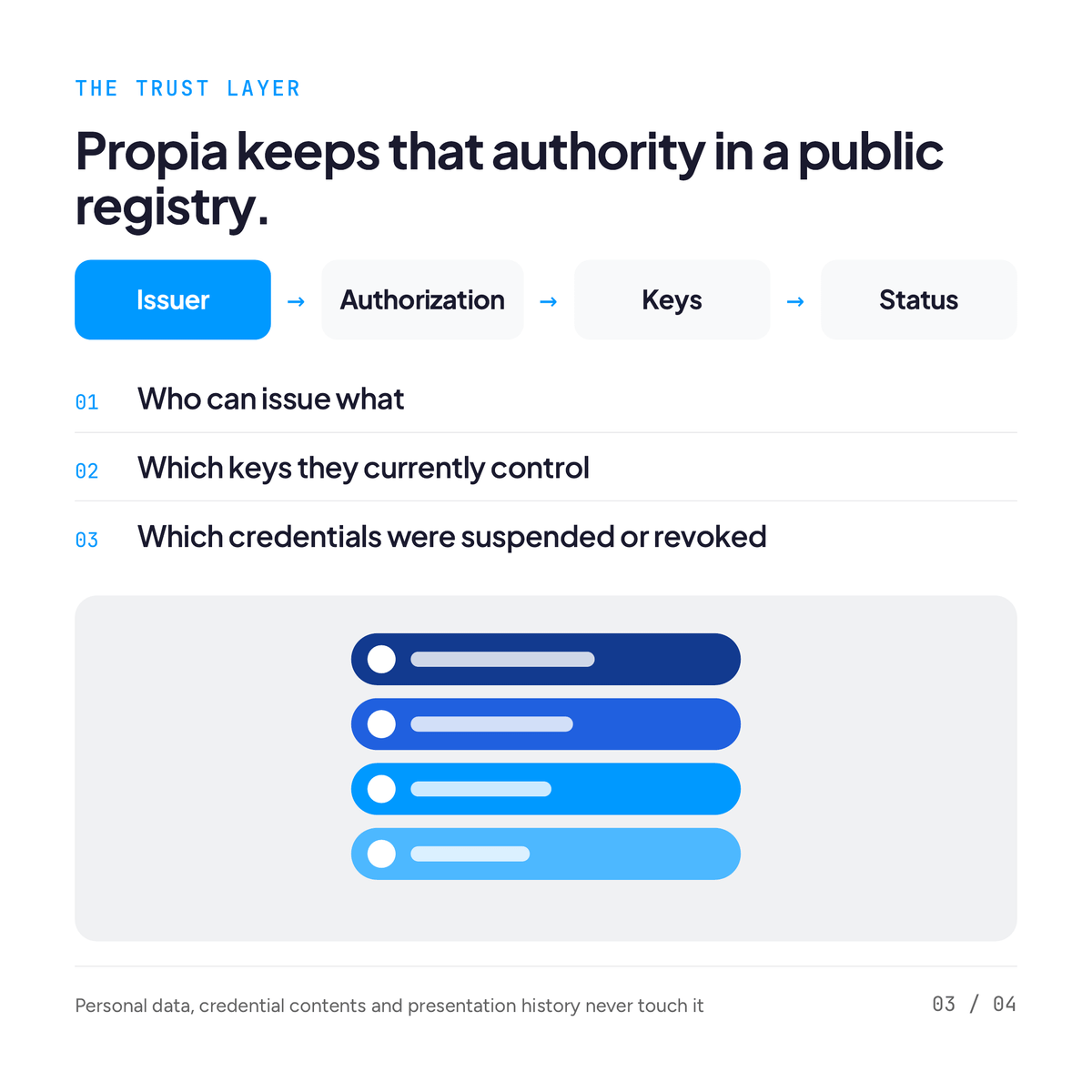
What's deliberately not in the registries matters just as much: no credential payloads, no names, no dates of birth, no photographs, no document numbers, no biometrics, and no record of where or when a credential was presented.
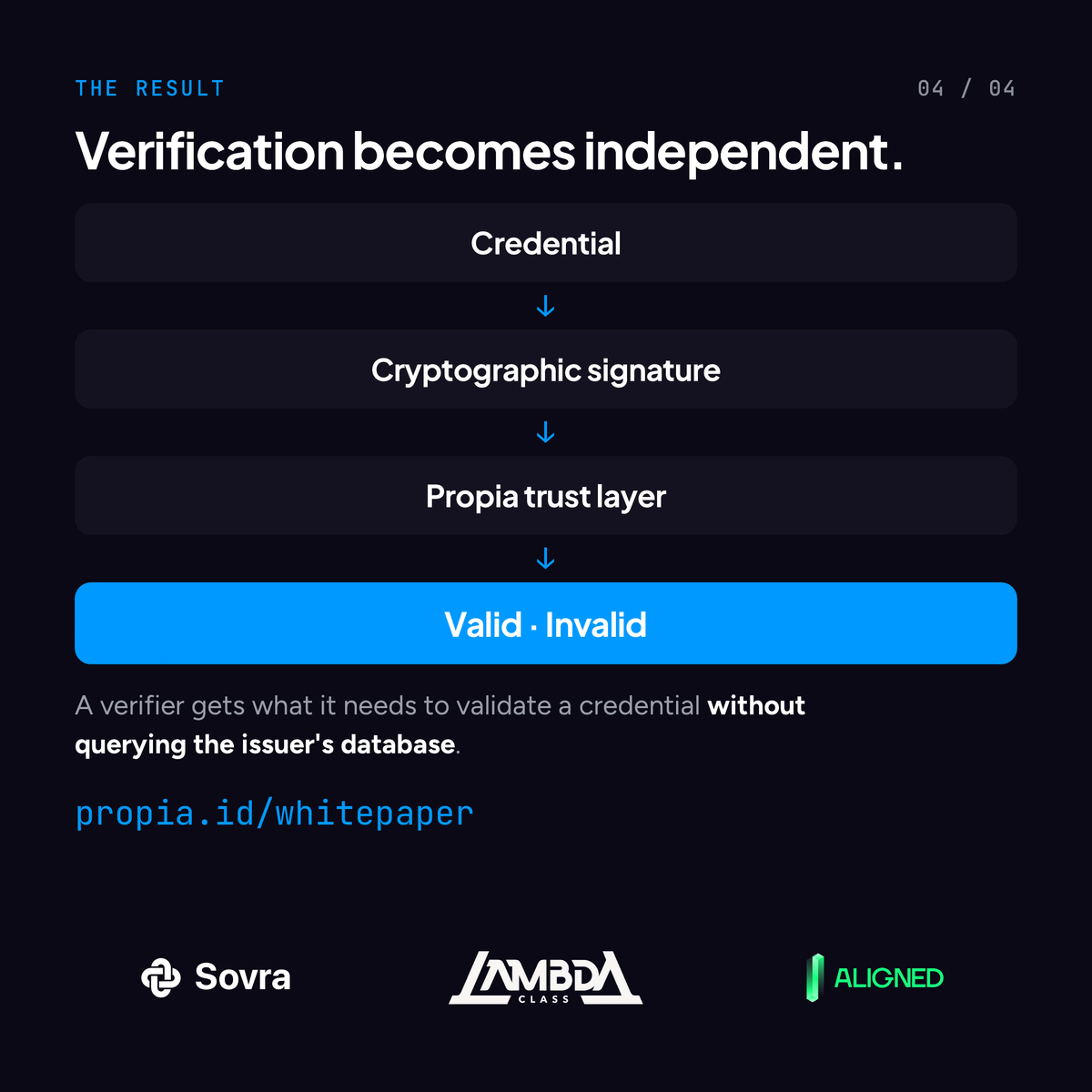
A verifier combines the credential the person hands them with the public trust state from Propia. It checks integrity, issuer authority, holder binding, temporal validity, and status. All five without a private callback to the issuer.
That last point is the one worth sitting with. When verification requires phoning the issuer, the issuer learns every place you use your credential, verification breaks when their service is down, and every verifier maintains a bespoke integration to every issuer. Reading a public registry removes all three problems at once.
Institutional authority stays exactly where it was. Governance authorities still decide who may issue what. Issuers remain responsible for identity proofing and for the accuracy of their claims. Propia represents that trust state and makes it independently verifiable. It does not create the authority, and it is not a universal identity database.
Why this compounds
The single-credential case saves a document upload. The interesting case is what happens when one institution's verified output becomes another institution's input.
A government issues a foundational identity credential. A university verifies it and issues a diploma to the same holder. A professional body verifies both before issuing a licence. An employer, bank, or public agency verifies the relevant credentials against the same public registries, without touching any of the others' databases.
None of these institutions needs access to any other's database. Each verifies a standardized presentation, applies its own legal and administrative rules, and may issue a credential of its own. As more compatible issuers and verifiers join, the number of useful credential combinations grows, and none of that network value accrues to a central platform.
This is also where the integration model changes. In a platform-based system, a central operator sits between issuers and verifiers and sees every interaction. With a shared protocol, new wallets, verification services, and applications participate without anyone's approval.
Why Ethereum, and why a validium
Public trust registries could be a shared database. That would give you a common interface and hand one operator control over availability, update ordering, and history. Every participating institution would then depend on that operator's continued good behavior and continued existence. For infrastructure that gates access to public services, education, finance, and employment, that's the wrong shape.
Ethereum is the right settlement layer here for reasons that are institutional as much as technical:
- Settlement control belongs to no issuer, government, or infrastructure provider, including us.
- Any participant can verify finalized commitments through their own node and their own client.
- Accepted state is finalized under proof-of-stake, with economic penalties for conflicting histories.
- Execution can happen at Layer 2 while Ethereum verifies succinct proofs.
That last property is what makes population scale affordable. Issuer authorizations change rarely, but status updates, key rotations, and recovery actions happen continuously across millions of wallets. Putting each one directly on Ethereum would make cost and throughput hostage to L1 blockspace.
So the architecture is an Ethereum validium with zero-knowledge validity proofs. State transitions execute off Ethereum and batch. Settlement contracts accept a state commitment only after verifying the corresponding proof. The data needed to reconstruct L2 state is kept available off-chain, which is precisely what buys the extra throughput over a ZK rollup that publishes it through Ethereum.
Being honest about the boundaries: a validity proof can stop an unauthorized issuer from being added, a status change without authority, or a controller replacement outside policy. It cannot tell you whether the institution's underlying decision was correct or whether identity proofing was done properly. And validity proofs say nothing about data availability, so every deployment has to define replication, retention, and independent state recovery for itself. Institutional authority, protocol validity, and operational security are three separate sources of assurance, and Propia is explicit about which one it provides.
Where Aligned fits
Propia's requirements read almost like a description of what we've been building. Open verification with no private agreement; institutional exit rights; population-scale throughput with a small settlement footprint; wallets people with no necessary crypto knowledge can actually use.
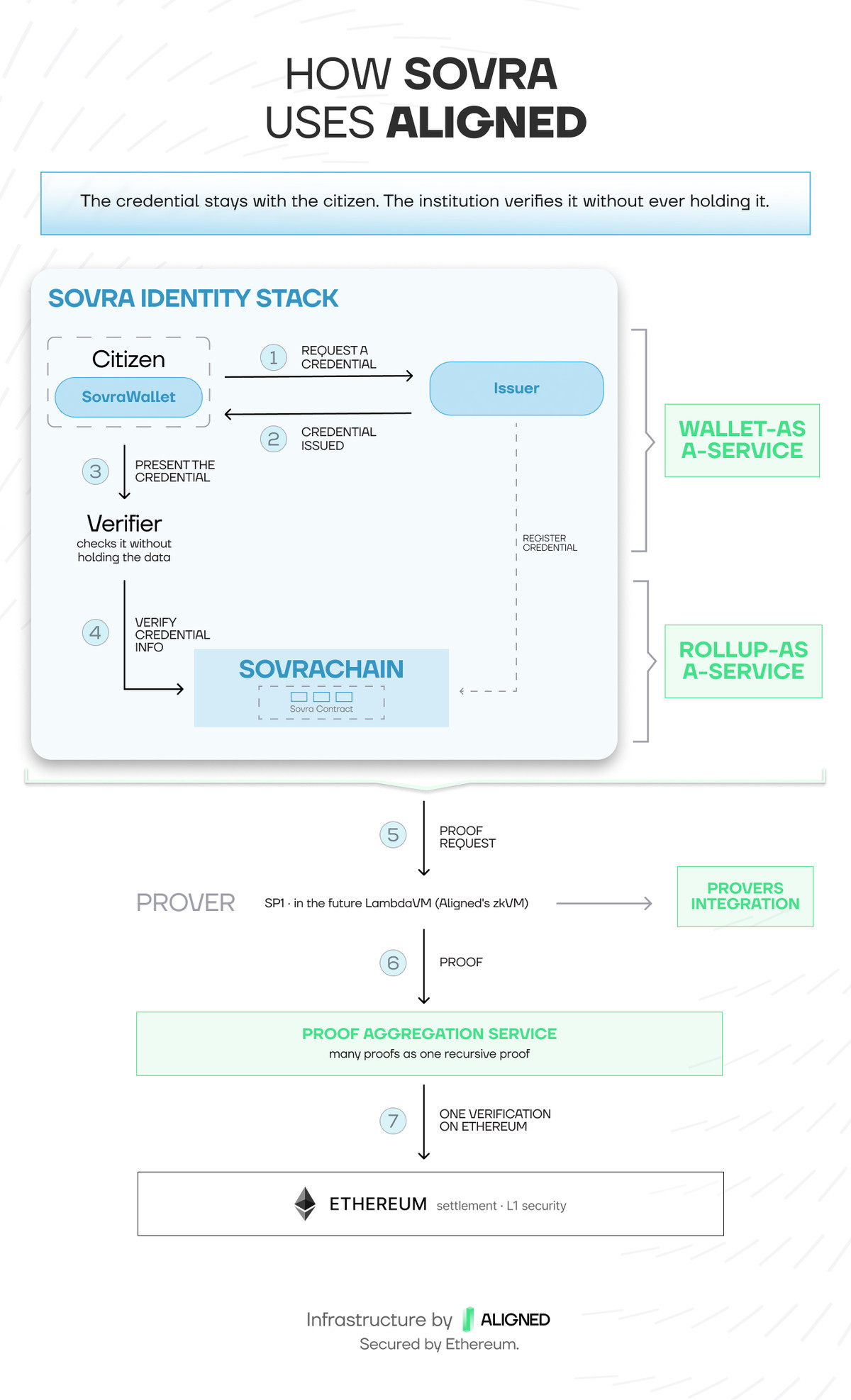
Rollup as a Service: SovraChain is an ethrex validium, deployed and operated through Aligned's RaaS. Because we vertically integrate the ethrex stack with our verification layer, there are fewer external dependencies between the protocol and Ethereum, which matters when the thing you're running is meant to outlive vendors and administrations.
Wallet as a Service: Credential infrastructure fails if people can't hold credentials. Our WaaS gives users a real Ethereum wallet from a familiar sign-in, with device-backed keys for authorization and no seed phrase to lose, plus transaction sponsorship so nobody needs to acquire a token to use a public service. Propia's identifier registry is what turns recovery from a vendor feature into a governed state transition: a credential bound to a stable identifier survives an authorized key change.
Proof aggregation: Our Proof Aggregation Service, live on Ethereum mainnet alpha, lets many proofs share a single verification on Ethereum. For a system whose whole economic argument rests on marginal cost per registry update, this is the difference between a pilot and a public utility. Migrating SovraChain onto aggregation is active work, and the savings land as the deployment scales.
Based sequencing, next: The whitepaper is direct that the protocol should move toward based sequencing once latency and availability requirements can be met, inheriting Ethereum's sequencing liveness instead of depending on a privileged sequencer. Based rollups are what we've been building toward from the start, and ethrex has supported based sequencing natively since day one. Public credential infrastructure is exactly the use case that justifies it.
Bogotá
On September 1, 2026, the Bogotá Mayor's Office announced the development phase of SuperApp Bogotá, a single app that gives the city's 8 million citizens access to government services and benefits from one place. The project is financed by CAF, the Development Bank of Latin America, and coordinated through the Consejería Distrital de TIC. The credential layer runs on Propia and SovraWallet, built with Lambda and Aligned.
Bogotá matters as a proof point for a specific reason: it is the capital of Colombia, a city of 8 million people, running on the same open protocol described in this post. When a citizen registers for a city benefit today, the credential issued to them can be verified by any compatible service without Bogotá's systems being called again. The city issues once; the credential travels.
Colombia has been building toward this for a while. It ran a verifiable credentials bootcamp in Bogotá where more than 40 public-sector developers built working pilots -including a rural digital ID and migrant permit credentials- in under 48 hours. The country is deliberately extending its existing identity system with open standards rather than replacing it with a proprietary platform. That is precisely the environment Propia is designed for.
Nuevo León
The week before Bogotá's announcement, the state of Nuevo León -the richest state in Mexico- launched NLínea, its state digital wallet together with Sovra. NLínea lets citizens carry official credentials on their phones and present them when needed. With biometric authentication and verifiable credentials issued by the state, it connects with Nuevo León's existing digital service portal, which already brings together 700+ government services. Every important government procedure in the state is now being built on this stack. The launch was presented at the 2nd Northeast Regional Meeting in Monterrey, organized by @nuevoleon and @ciapem, where Governor Samuel García opened the event.
The point worth making about Bogotá and Nuevo León together is that two independent governance authorities, in two countries with different legal systems and different trust frameworks, ran the same protocol underneath.
A verifier in Mexico City can check a NLínea credential with the same software that checks a Bogotá SuperApp credential. That's what cross-jurisdictional composability looks like when it stops being theoretical.
Why we're doing this
Aligned's goal is to make Ethereum a viable backend for real institutions. No project we've worked on shows what that requires in practice more clearly than Propia.
It is not a token launch or a wallet product, it's public infrastructure, and the whitepaper commits to what that means: specifications and core contracts open for independent implementation; reference software under an open licence; reading the registries and verifying credentials without a private agreement; issuers free to change vendors and keep their already-issued credentials working, and governance changes that are visible and auditable. Commercial services (wallets, issuer portals, compliance tooling, managed infrastructure) compete above that layer. Including ours. That's the correct arrangement, and it's the only one institutions should accept for infrastructure this consequential.
The overall objective of Propia is making institutional trust portable, auditable, and composable without exposing personal data to shared public state.
Read the Propia whitepaper for the full design, and if you're a government or institution with a credential system on your roadmap, you can reach out to Sovra and Aligned. We're ready to help you build it.
Propia was developed by Diego Fernández, Jesús Cepeda, Alejandro Garza, and Lucas Jolias (Sovra); Federico Carrone and Matías Onorato (Lambda); and Roberto José Catalán and Diego Kingston (Aligned).