How Aligned Wallet-as-a-Service helps fintechs and enterprises onboard users to Ethereum
Crypto onboarding puts seven decision points between a user and their first transaction. Aligned Wallet-as-a-Service brings it down to three: sign in, act, done. Here is how it works and how to measure it.
TL;DR
- The standard wallet onboarding path puts seven steps between a new user and their first transaction. Six of them are chances to leave.
- Aligned's Wallet-as-a-Service reduces the path to three: the user arrives, signs in with Google or a passkey, and executes.
- The gas, the routing and the key management did not disappear. They moved from the user to the infrastructure, which is where they belonged.
Every step between a user and their first transaction is a place they can leave.
That's the wallet problem. Not that wallets are hard to build, but that the standard path asks a first-time user to make six decisions before anything happens. Install this. Write down these words. Pick this network. Buy this token. Approve this contract. Then, finally, do the thing they opened your product to do.
Ethereum runs every day, in every market, with the deepest liquidity for financial applications. The friction isn't Ethereum. It's the wallet standing in front of it.
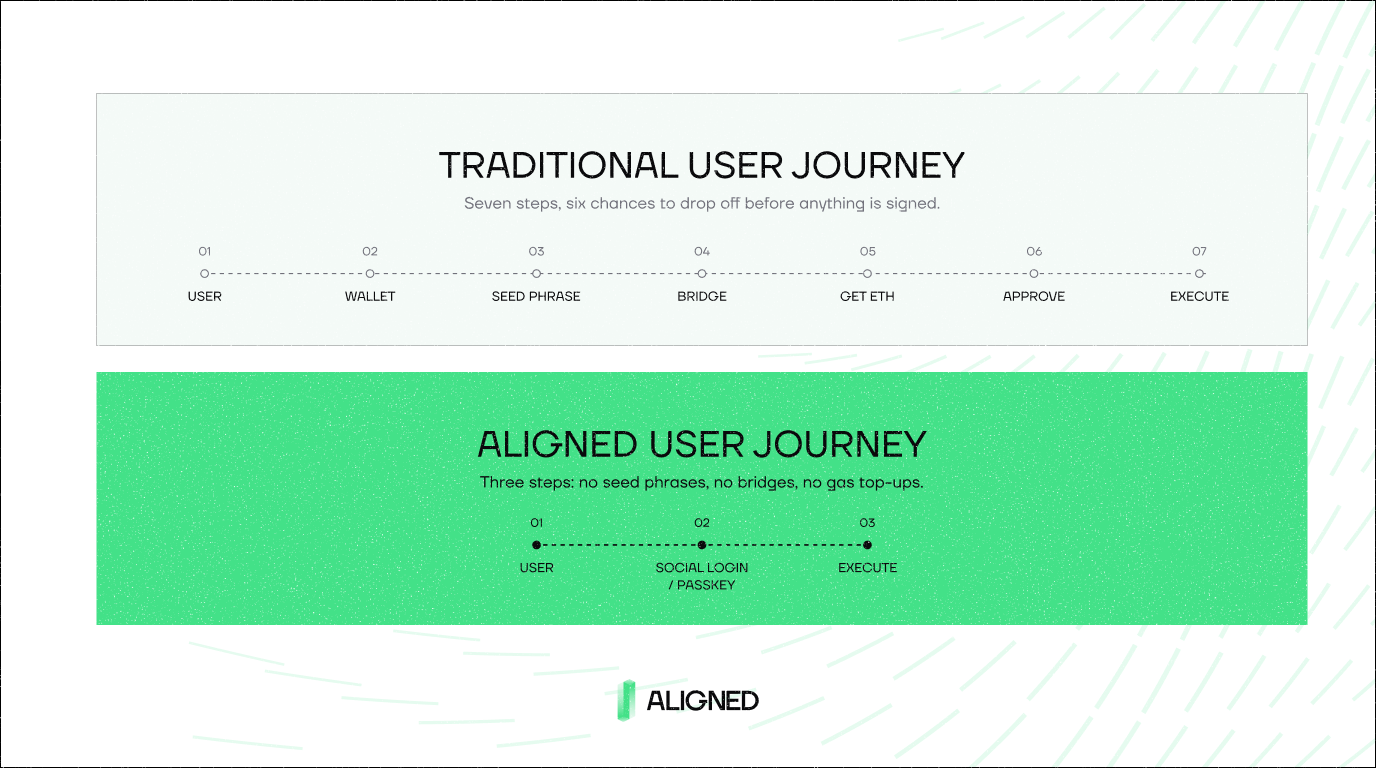
The traditional journey
01) User. Someone opens your product to send money, get paid, or hold a balance. That's the whole intent. Everything after this is overhead they didn't ask for.
02) Wallet. They leave your product to install a browser extension or separate app, then create an account inside it. Your onboarding now runs through a vendor you don't control and a screen you didn't design.
03) Seed phrase. Twelve words appear. Write them down. Lose them and the money's gone. Leak them and it's stolen. This is where a first-time user stops to think, and thinking here is expensive.
04) Bridge. They choose a bridge, then a source network, then a destination network. Get it wrong and the funds sit somewhere they can't see. Support hears about this one.
05) Get ETH. The transaction moves a stablecoin, but the network fee is paid in ETH. So they need a second asset, through a second payment flow, before the first one can move.
06) Approve. A permission prompt appears with a contract address and broad spending language. To a user who's been warned about scams all year, it reads like one.
07) Execute. They accept a fee that changed while they were reading it, then wait for a confirmation with no progress bar.
Drop-off doesn't add up across these steps. It compounds. A path that holds 80% of users at every stage keeps roughly a quarter by the end. Each user who does make it through costs more to acquire, and the ones who make it halfway generate the support tickets: where did my transfer go, why do I need ETH, I lost my phrase.
The Aligned Journey
01) User. Same person. Same intent.
02) Social login or passkey. They sign in with Google. The wallet is created behind that sign-in and lives inside your interface, not in a separate extension. They authorize with a passkey: Touch ID, Face ID, or their device's screen lock. No seed phrase is shown because there's none to show.
03) Execute. The transaction goes out. Your product sponsors the network fee, so the user never holds ETH. Your product handles routing, so the user never picks a bridge. The confirmation your interface shows is the one the user was expecting: the payment went through.
Three steps. One decision that belongs to the user, whether to make the payment at all.
Under the hood
The requirements didn't vanish. Fees still get paid, networks still get selected, keys still exist. Aligned's Wallet-as-a-Service moves that work out of the user's hands.
For the technical reader, this is what that means:
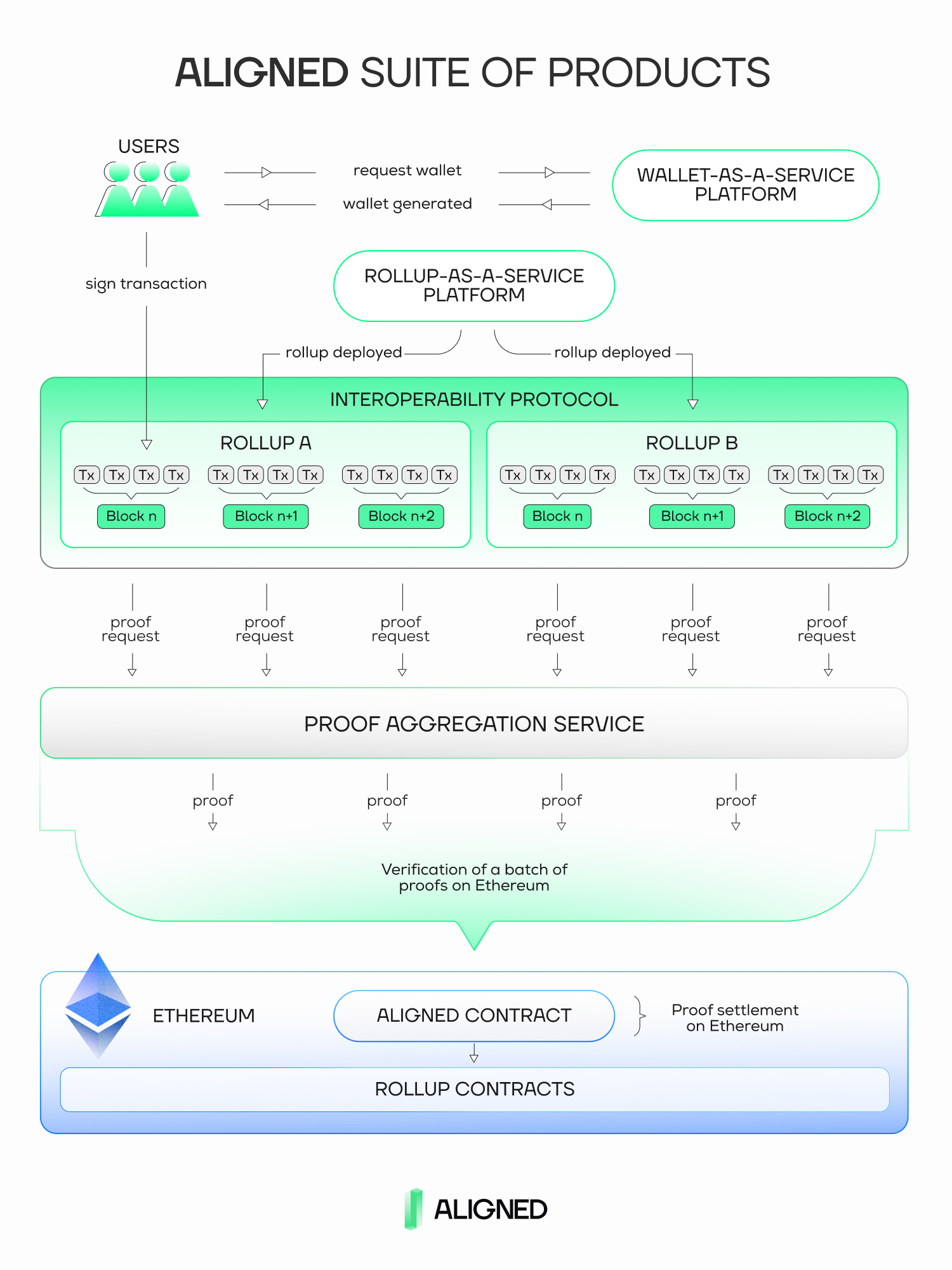
The wallet is a smart contract wallet using account abstraction, with EIP-7702 and RIP-7212 support. Signing in and signing a transaction are separate steps — what makes sign-in-based onboarding possible at all.
Signing runs on WebAuthn passkeys. The key is generated in the device's secure enclave. When it syncs across devices, iCloud Keychain or Google Password Manager encrypts it end to end. Apple and Google can't read it.
Every transaction is co-signed 2-of-2 by the user's passkey and by Aligned. A compromised device alone can't drain the wallet, and Aligned alone can't move funds. Independent retrieval of the server key -so users keep access even if our side stops co-signing- is in progress and not yet shipped.
A Paymaster sponsors gas on the user's behalf. That's what removes step 05.
Recovery runs through a server guardian with a timelock and multi-factor authentication, for the case where a user loses every device.
The wallet is native to Aligned's L2 stack, built on Ethrex, the Rust Ethereum execution client from LambdaClass. One provider for the wallets, the proofs, and the chain.
We showed the full flow publicly in February 2026: sign in with Google, send USDT signed with Touch ID, then open the wallet on a different device and send again with the synced passkey.
wanted to share our first public demo of @alignedlayer wallet as a service.
— RJ 🟩 (@rj_aligned) February 26, 2026
our engineering team has been doing an incredible job. really proud of how fast we’re building this.
this is a key product for us. it’s how we help partners like @sovraio onboard millions of users in a… pic.twitter.com/ipna3RUCN4
The early partners for this product are teams that need to onboard millions of users who've never touched a blockchain. Sovra is one of them, government digital identity infrastructure serving 6M+ people in Latin America.
How to measure the difference
Run a cohort comparison. Take 10,000 users through your existing flow, then 10,000 through Aligned's, with the same traffic source and the same product intent.
Watch three things:
Same-session activation: the percentage of users who complete their first transaction in the same session they signed up. Traditional wallet flows push this below 40% because users need to leave your product, buy ETH, install extensions, then return. The Aligned cohort should hit above 75% — users sign in, transact, done.
Support volume by category: segment your tickets into wallet-related versus product-related. In the traditional cohort you'll see: "lost seed phrase", "wrong network", "need ETH for gas", "stuck transaction". In the Aligned cohort these collapse to near-zero because users never see a seed phrase, never choose a network, never need to buy ETH, and get clear confirmations.
Median time to second transaction: first transaction proves the setup works. Second transaction proves the user understood it and will come back. Traditional flows stretch this to days. With Aligned, target under 24 hours for transactional products, under a week for balance-holding products.
The real test isn't comparing activation percentages in isolation, your existing funnel already pre-selected users willing to deal with wallet complexity. Run paid acquisition to a new segment, users who would've bounced at the wallet step, and watch if unit economics shift. That's where you see the difference.