Case Study - Stablecoin Payments on Ethereum: What a Fintech Needs Beyond the Stablecoin
Ethereum already has the dollars. A payment product also needs accounts, predictable costs, controls and reach, and Aligned Layer delivers them through a single integration.
Summary
A stablecoin gives every fintech a dollar that is available at any hour, on any day. But a payment product needs more: an account for every customer, a predictable cost per payment, control over who transacts, and above all, reach to the liquidity already on Ethereum. Aligned Layer delivers those pieces through a single integration, so a team can run stablecoin payments on Ethereum without stitching together 10+ vendors first.
Key facts
- Ethereum holds more stablecoins than any other network: more than $130 billion as of November 12, 2026, according to DefiLlama.
- Stablecoin payments grew 45% to $482 billion through September 2026, while supply grew 0.4%, according to Allium.
- Aligned Layer's Wallet-as-a-Service gives every user of an application a non-custodial Ethereum wallet at sign-in, with no seed phrase to write down and no gas token to buy.
- Aligned Layer's Rollup-as-a-Service gives a company a dedicated chain that settles on Ethereum, built with ethrex, LambdaClass's Rust Ethereum client. It is in production with selected partners.
- Everything runs through a single integration for wallets, payments, and settlement.
On October 15, 2026, Allium reported that stablecoin payments grew 45% to $482 billion through September, while supply grew 0.4%. The same dollars are changing hands more often. The figure is a conservative one: of $97.9 trillion in raw stablecoin transfers, Allium counts 2.5% as end-user activity, and payments are a part of that.
Ethereum already has the dollars. It holds more stablecoins than any other network, and getting one is becoming a service a company can buy: in July 2026, Visa introduced a platform for financial institutions and fintechs to mint, move, and manage stablecoins.
Our thesis: the stablecoin is the solved part. What decides whether a fintech can run payments on Ethereum is the infrastructure around the stablecoin, and that infrastructure can now come through one integration.
Where do the dollars sit, and where do payments happen?
Ethereum is where the dollars are held and where high-value settlement happens. In December 2025, the average stablecoin address on Ethereum moved $32,000 in the month, according to zerohash's 2026 Stablecoin Momentum Report, which uses RWA.xyz data and describes Ethereum as the primary hub for high-value settlement.
Everyday payments are a different workload: many small transfers, where every fee counts. The same report finds that Ethereum held the largest share of stablecoin supply but about 14% of active stablecoin addresses as of December 1, 2025. It reads the gap as payment activity, driven by embedded wallets and fintech platforms, concentrating on networks with lower fees. Two limits apply: an address is not a person, and the snapshot is from December 2025.
For a fintech, that has looked like a choice between building where the dollars are and building where payments are cheap. The rest of this article is about having both: accounts customers can use from day one, and a chain with a fee structure the company controls that settles on Ethereum and stays connected to it.
What does one payment need?
Follow one payment to see what that infrastructure has to do. Think of a customer who opens a remittance app, receives $200, and wants to send $50 to a relative. For that to happen, the customer needs an account. The company needs to know what the payment costs and who is allowed to make it. And the money has to reach the place where the relative can use it.
At both ends, licensed providers convert between bank money and stablecoins. Félix, which lets people send remittances from the United States to Latin America through a WhatsApp chat, uses Bridge, a Stripe company, for currency conversion, according to Stripe. The full path looks like this:
Sender's bank → licensed provider → stablecoin → customer's wallet → payment → licensed provider → local currency
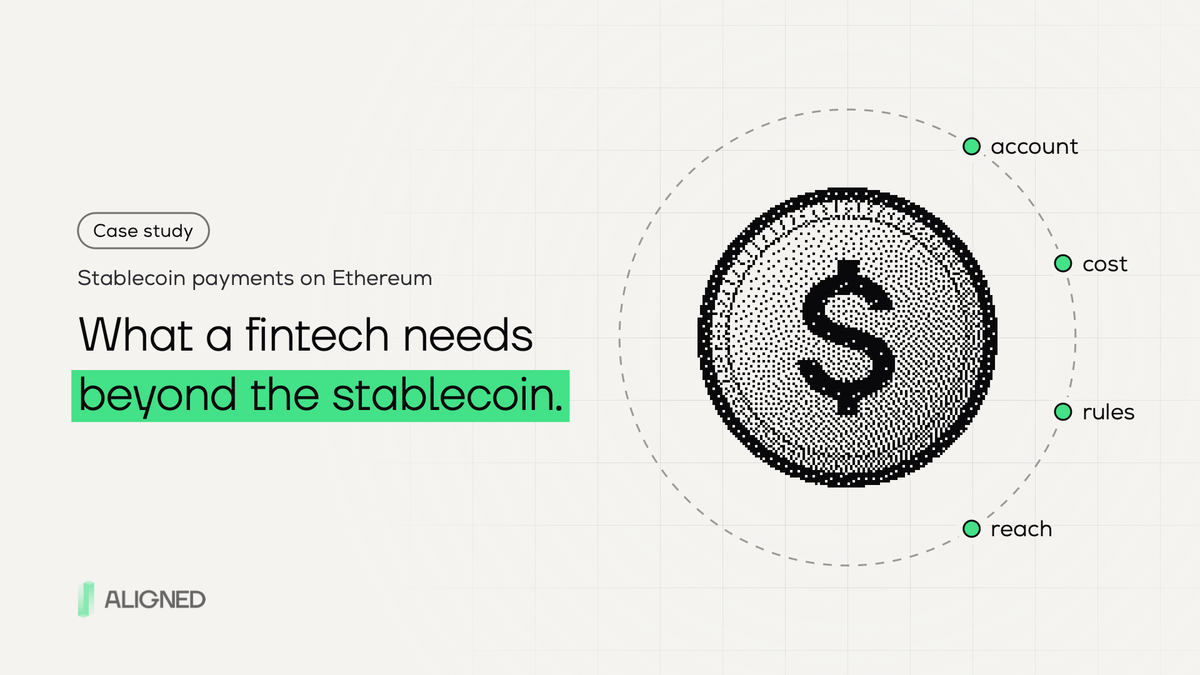
The account, the cost, the rules, and the reach are the middle of that path, and they are what this article covers.
Today, a company that wants to ship that middle on Ethereum has to assemble a separate vendor for each step.
| What the payment needs | Assembled separately | With Aligned Layer | Status |
|---|---|---|---|
| An account for every customer | A wallet provider | Wallet-as-a-Service | In use: Sovra is an early partner |
| A predictable cost and the company's own rules | A chain provider and proof infrastructure | Rollup-as-a-Service, settling through the Proof Aggregation Service | Rollup-as-a-Service: in production with selected partners. Proof Aggregation Service: live on Ethereum mainnet (alpha) since January 2026 |
| Reach to the stablecoins already on Ethereum | A bridge | Interoperability | Under active development. Designed as a native bridge between chains powered by Aligned Layer, alongside standard L1 bridging to Ethereum |
How does the customer get an account?
Every customer with their own balance on Ethereum needs a wallet. A traditional wallet adds setup steps, such as a separate app, a seed phrase, and a token to buy for fees, and each extra step costs new sign-ups.
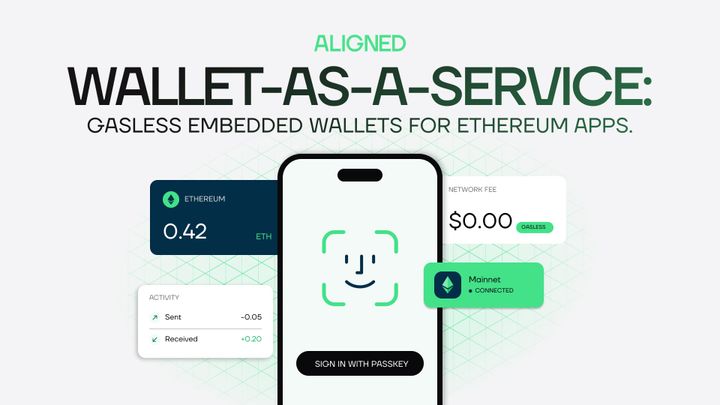
Aligned Layer Wallet-as-a-Service puts a non-custodial wallet behind the app's existing sign-in. The customer signs in with email or Google, sees the $200, and confirms the $50 payment with Face ID, a fingerprint, or a screen lock. Aligned Layer submits each transaction and pays the gas, so customers never need to hold the chain's native token.
The wallet is non-custodial. Every account has a two-signature rule enforced on-chain, so no single party, including Aligned Layer, can move a customer's funds alone.
What does the payment cost, and who is allowed to make it?
Launching on Ethereum L1 is the right first move for most fintech companies, and the wallet works there. As the app grows, the cost of each payment becomes the question.
Gas on Ethereum L1 is a market. When demand for blockspace rises, the price rises for everyone, and a product with high throughput feels that variance on every transaction. On its own chain, a company controls the fee structure and keeps it predictable.
Aligned Layer Rollup-as-a-Service gives a company that dedicated chain, built with ethrex, settling on Ethereum through Aligned Layer's Proof Aggregation Service, live on Ethereum mainnet (alpha) since January 2026. Ethereum verifies a proof that each batch executed correctly, so the chain inherits Ethereum's security.
The same chain answers the second half of the question. Many financial products need control over who participates in their ecosystem, and they need it to be seamless for the customer. On a company's own chain, the rules for permissioned transactions can be embedded directly in the sequencer: who transacts, which assets move, and under what conditions, enforced by the chain itself.
How does the money reach the rest of Ethereum?
The $50 is only useful if it can leave the app. A dedicated chain is only an advantage if it can still reach the assets customers already hold, and most of those live on Ethereum.
Aligned Layer's Interoperability, which is under active development, is designed to keep that reach intact: chains powered by Aligned Layer will move value between each other through a native bridge, and they connect to Ethereum through standard L1 bridging. A company gets a chain built around its product without giving up the stablecoins already on Ethereum.
One team behind the whole payment
Assembled separately, that single payment crosses a wallet provider, a chain provider, a bridge, and proof infrastructure. Each vendor is its own contract and its own party to trust, and support tickets, upgrade schedules, and liability all get contested at the seams between them.
Aligned Layer builds all of that in-house and delivers it through a single integration. The same wallet works on Ethereum L1 and on the chains built with ethrex, each customer keeps the same address on every chain, and one team answers for all of it.
The trade-off is concentration in that one team. Aligned Layer narrows it by keeping the entire stack open source, so anyone can read, fork, or run the code.
The stack already carries a demanding workload. Sovra, Aligned Layer's first Rollup-as-a-Service partner and an early Wallet-as-a-Service partner, runs digital identity for 8M+ people across Argentina, Mexico, and Colombia. Government identity puts uptime, cost, and data handling under public scrutiny, and Sovra runs it in production today. It is an identity workload, not a payments one.
The dollars are on Ethereum. The next step is the product running there too, from a customer's first sign-in to final settlement, through a single integration. The full stack is described here.
What would change this view?
Three things we will be watching:
- Activity on Ethereum L1. If the share of active stablecoin addresses on Ethereum rises toward its share of supply, more payment products can stay on L1 for longer, and a dedicated chain becomes a later step.
- Payment growth. Allium publishes quarterly. If payments stop growing faster than supply, the demand side of this argument weakens.
- Figures by network and by region. Allium's report is global. A breakdown that showed small payments settling somewhere else for reasons other than fees would change what a fintech should build first.
FAQ
Do customers need to buy a token to pay fees?
No. Aligned Layer submits each transaction and pays the gas, so customers never need to hold the chain's native token.
Who can move a customer's funds?
Every account has a two-signature rule enforced on-chain, so no single party, including Aligned Layer, can move a customer's funds alone. Aligned Layer Wallet-as-a-Service is non-custodial.
Does a fintech need its own chain from day one?
Launching on Ethereum L1 is the right first move for most fintech companies. A product that starts with an embedded wallet can later add its own chain that settles on Ethereum from the same team, with each customer keeping the same address on every chain.
Is Aligned Layer Rollup-as-a-Service available today?
Aligned Layer's Rollup-as-a-Service is in production with selected partners.
Explore our developer docs