What is Aligned? The Five-Product Ethereum Stack
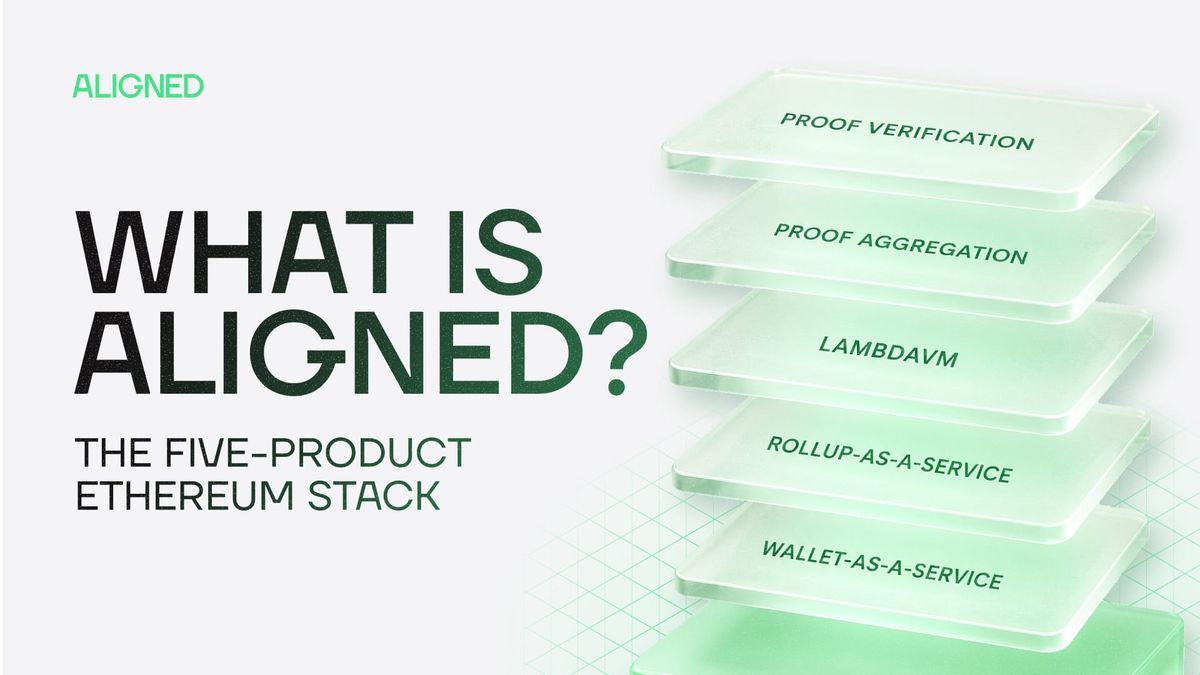
Aligned is the full stack for building financial products on Ethereum, with five products (Proof Aggregation Service, Wallet-as-a-Service, Rollup-as-a-Service, Interoperability, and Lambda VM) that ship through a single integration.
Summary
Aligned is the full stack for building financial products on Ethereum, with five products (Proof Aggregation Service, Wallet-as-a-Service, Rollup-as-a-Service, Interoperability, and Lambda VM) that ship through a single integration. Together these offerings close the gap between what Ethereum guarantees and what an enterprise-grade financial product actually needs to run.
Key facts
- Aligned's Ethereum stack centers on five core offerings (the Proof Aggregation Service, Wallet-as-a-Service, Rollup-as-a-Service, Interoperability, and Lambda VM, Aligned's zkVM (built in collaboration with Lambda Class and 3MI Labs).
- Aligned's rollups are built with ethrex, LambdaClass' open-source Rust Ethereum client.
- Sovra, Aligned's first Rollup-as-a-Service partner and an early Wallet-as-a-Service partner, runs digital identity for 6M+ people across Argentina, Mexico, and Colombia.
- Aligned's Proof Aggregation Service settles proofs with Ethereum's own security, with no separate validator set to trust.
- The stack is fully open source and independently audited, built by the team behind LambdaClass, which made core contributions to Starknet, zkSync, and Polygon Miden.
Fintechs, institutions, and enterprises use Aligned to build financial products on Ethereum. Aligned is a full stack of five vertically integrated products for Ethereum, built by an independent team founded by LambdaClass veterans and delivered through a single integration.
We believe Ethereum is the most ambitious and long-term project on the internet, and we're building Aligned to help it achieve its highest potential.
What does Aligned do? The groundwork for building financial products on Ethereum
Aligned builds and operates the infrastructure that sits between your product and Ethereum, and takes on the challenges that would otherwise fall on your team. Your users have never held crypto, so they need wallets that don't ask them to manage keys or gas. Gas on Ethereum is a market, so a high-throughput product feels every swing in demand for blockspace. And every transaction has to be proven correct back to Ethereum, while value has to move between your chain and the liquidity already there.
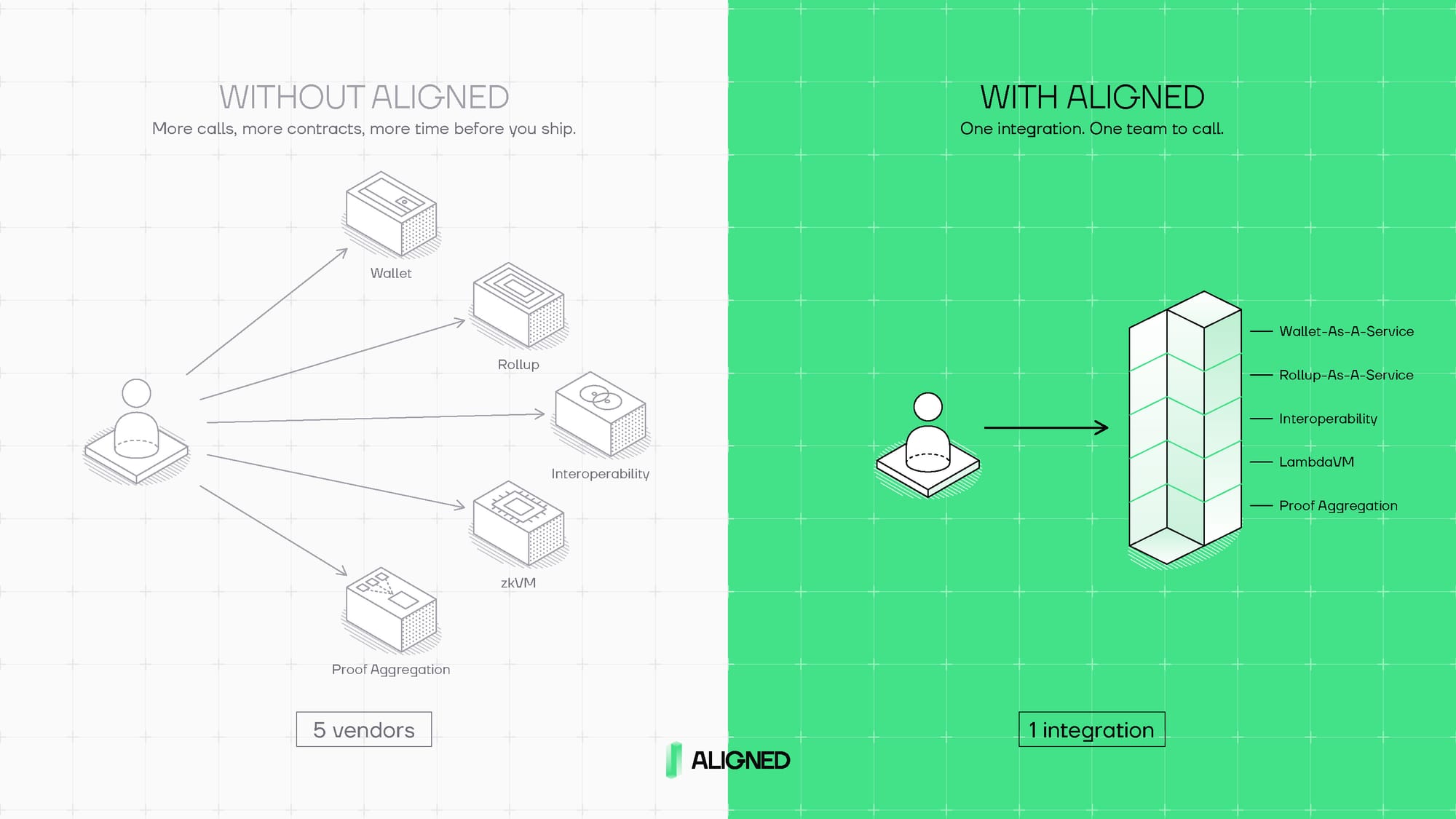
Today, a company that wants to ship a financial product on Ethereum has to assemble separate vendors for embedded wallets, a dedicated rollup, interoperability, and proof infrastructure, then stitch together 10+ vendors before writing any product code. Each vendor is its own contract and its own party to trust, and support tickets, upgrade schedules, and liability all get contested at the seams between them.
We build all of that in-house and deliver it through a single integration.
The Aligned stack at a glance
| Product | Description | Function |
|---|---|---|
| Proof Aggregation Service | Recursive proof aggregation verified on Ethereum | Combines many ZK proofs into one so every proof in a batch shares a single verification cost |
| Wallet-as-a-Service | Embedded non-custodial wallets built on EIP-7702 smart accounts | Onboards users with a passkey, with no seed phrase and no gas token to acquire |
| Rollup-as-a-Service | One-click deployment of ZK rollups built with ethrex that settle on Ethereum | Gives teams dedicated Ethereum L2s with ZK-proof settlement, with based sequencing support coming |
| Interoperability | Native bridging between Aligned-powered chains plus standard L1 bridging | Connects applications to the stablecoins and DeFi liquidity on Ethereum |
| Lambda VM | Aligned's zkVM, built with LambdaClass and 3MI Labs | A RISC-V proving engine designed around post-quantum cryptography, in active development |
What products does Aligned offer? From proof aggregation to proving execution
Each core Aligned offering answers a question institutions often ask before committing to Ethereum: what verification costs, how users onboard, where the application runs, how value moves, and what proves the computation.
Proof Aggregation Service
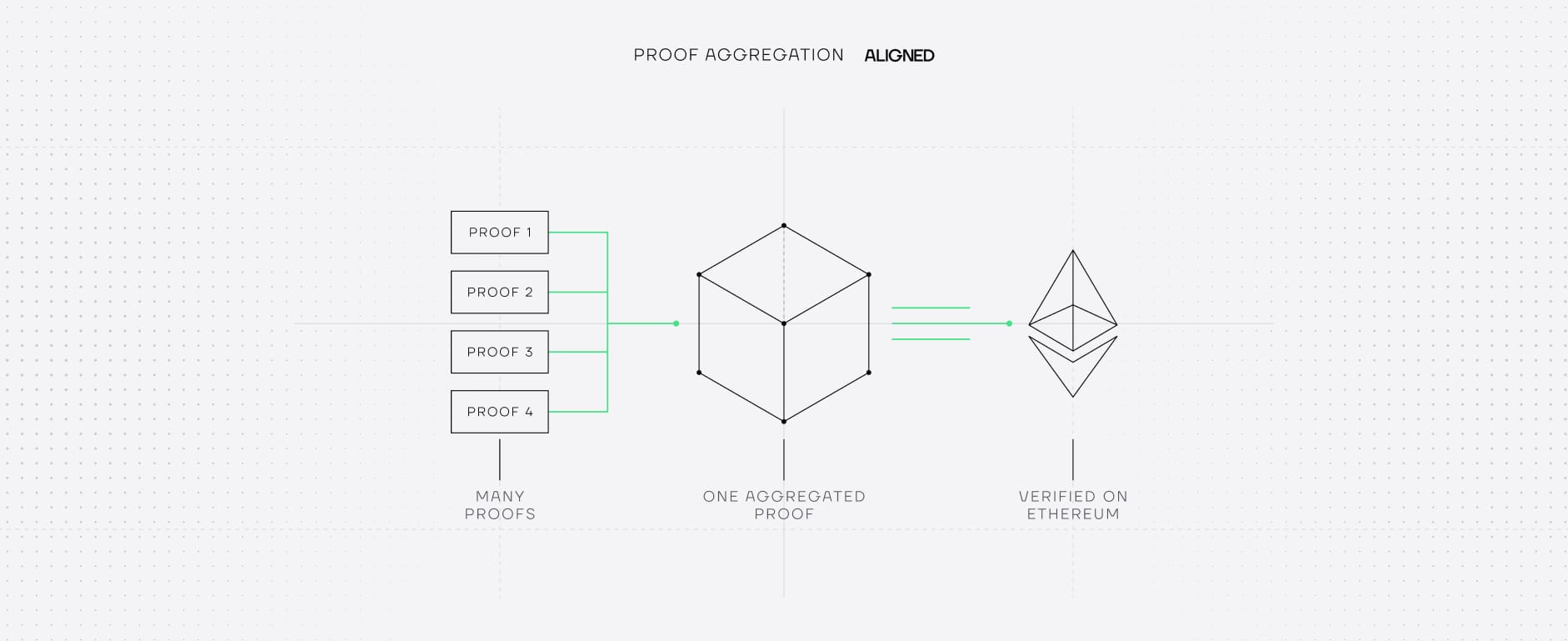
Aligned's Proof Aggregation Service combines multiple ZK proofs into a single proof that Ethereum only needs to verify once. Verifying a single proof directly on Ethereum typically costs around 250,000 gas for a Groth16 proof and over 1,000,000 for a STARK, and throughput tops out around 10 proofs per second. As a result, applications that generate a significant number of proofs often get priced out if they need to verify them one at a time.
Recursion solves this. You submit proofs, we aggregate them into one recursive proof that attests to all of them, and Ethereum verifies that single proof for around 300,000 gas. Every proof in the batch shares that one verification cost, so your share falls as the batch grows.
Because an Ethereum smart contract checks the final proof, there's no separate validator set to trust and no cryptoeconomic assumption. The security is Ethereum's own. Aligned's aggregator can censor a proof by leaving it out of an aggregation, but it cannot cause an invalid proof to be accepted.
The Proof Aggregation Service has been live on Ethereum mainnet (alpha) since January 2026. It currently accepts SP1 compressed proofs, and the stack is designed to support any proof system. The trade-off is a delay: proofs settle within an aggregation window that defaults to 24 hours. That wait suits rollups that need Ethereum's full cryptographic security on every batch they post, with withdrawals to Ethereum finalizing once the aggregated proof is verified.
Wallet-as-a-Service
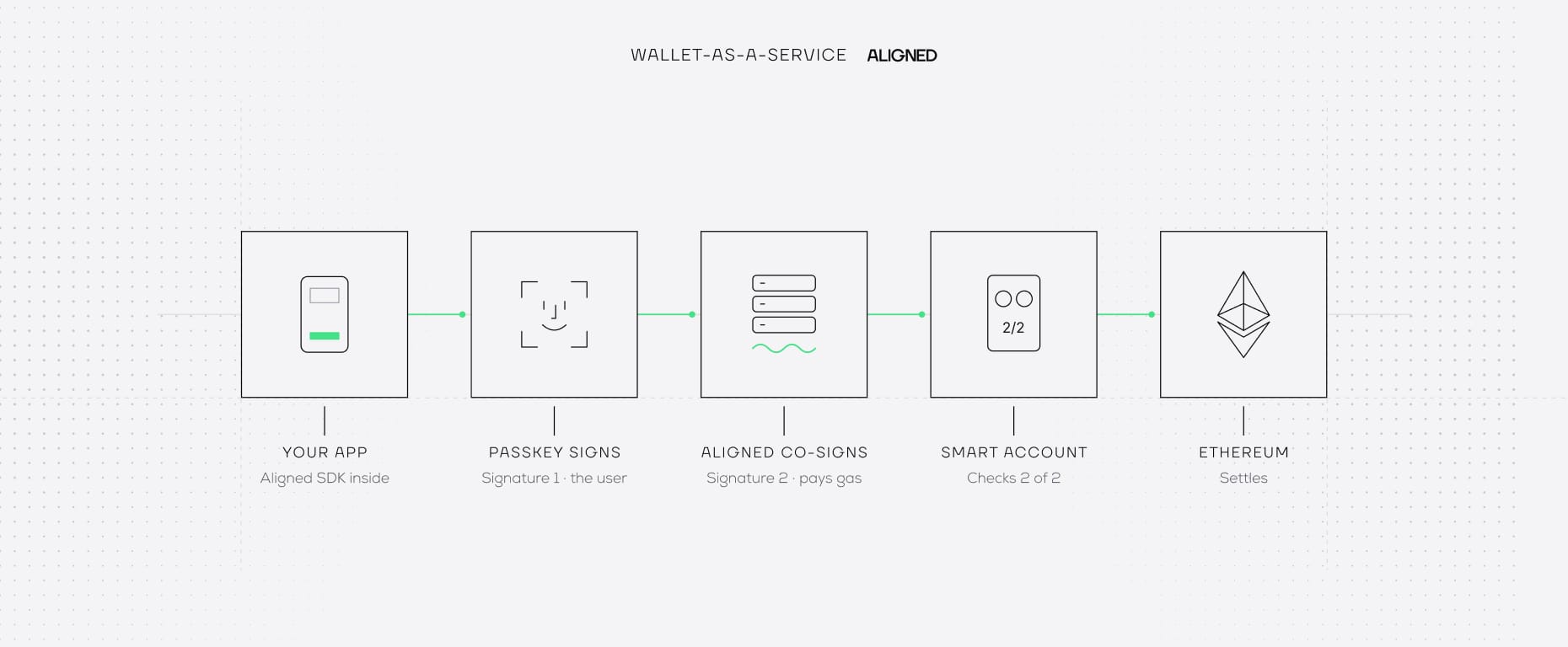
Aligned's Wallet-as-a-Service embeds a non-custodial wallet inside your application, so users can sign in with a passkey and skip wallet setup. This means no seed phrase to write down, no gas token to buy before a first transaction, and no network to select. The underlying requirements: key management, signing, and gas payment still happen. They just happen inside Aligned's stack, where your users never see them.
Every Aligned account is a smart account: a regular externally owned account (EOA) delegated via EIP-7702 to dedicated smart-contract code. That code enforces a 2-of-2 rule: a transaction is valid only with one signature from the user and one from our backend. The rule lives in publicly deployed bytecode, so compromising our infrastructure doesn't compromise user funds, because the contract refuses any call without a valid user signature.
Aligned's backend relays transactions and covers the gas, so your users never need to hold the chain's native token just to transact. If an account ever needs recovery, you can configure an optional timelocked guardian for it. And the same wallet works on Ethereum L1 and on L2 rollups built with ethrex.
Rollup-as-a-Service
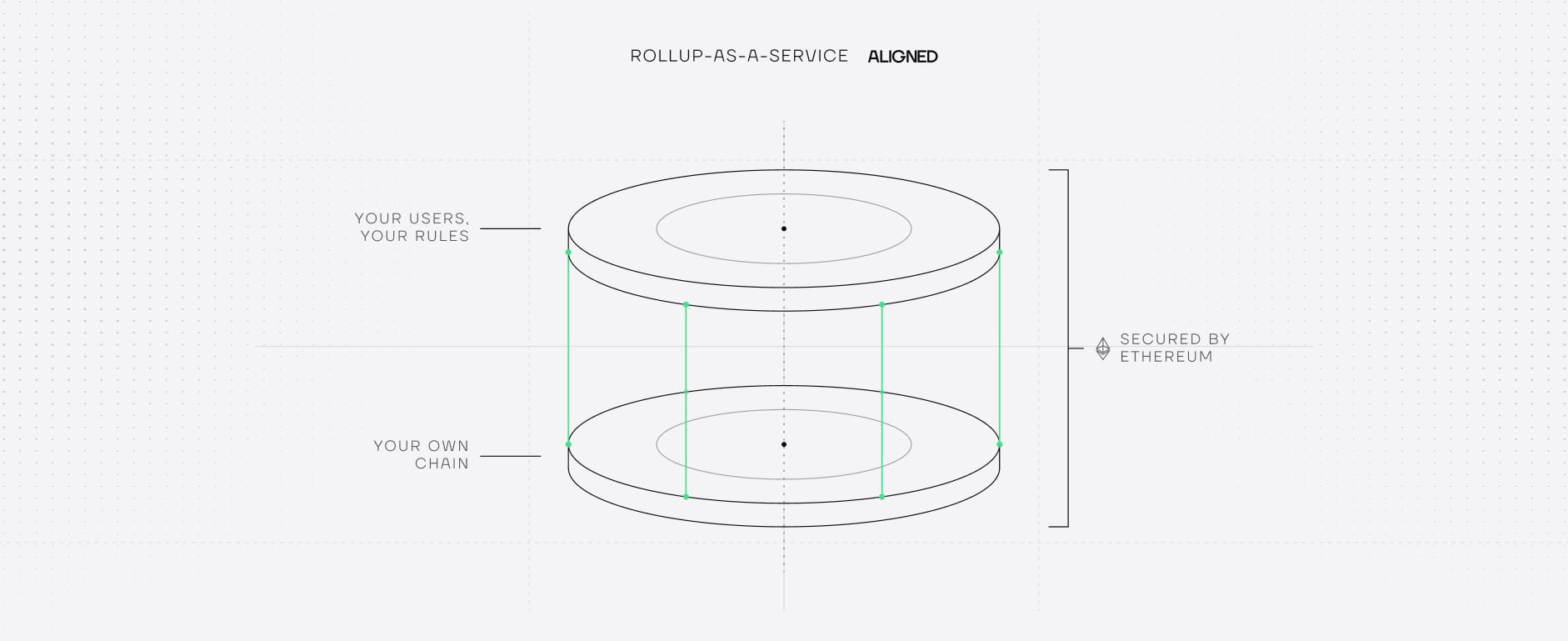
Aligned's Rollup-as-a-Service gives you a dedicated chain: one-click deployment of a ZK rollup, built with ethrex, that settles on Ethereum through the Proof Aggregation Service. On Ethereum L1, fees and features are protocol decisions made for the whole network. On your own chain, they become product decisions: you customize the features you offer to your users and can embed rules for permissioned transactions directly in the sequencer. That control matters once you're running a product with real uptime and cost commitments.
Aligned will also support based sequencing, where Ethereum L1 governs who orders the rollup's transactions instead of a single operator; ethrex is building toward it.
ZK (validity) proofs mean there's no challenge window: Ethereum verifies a proof that each batch executed correctly.
Interoperability
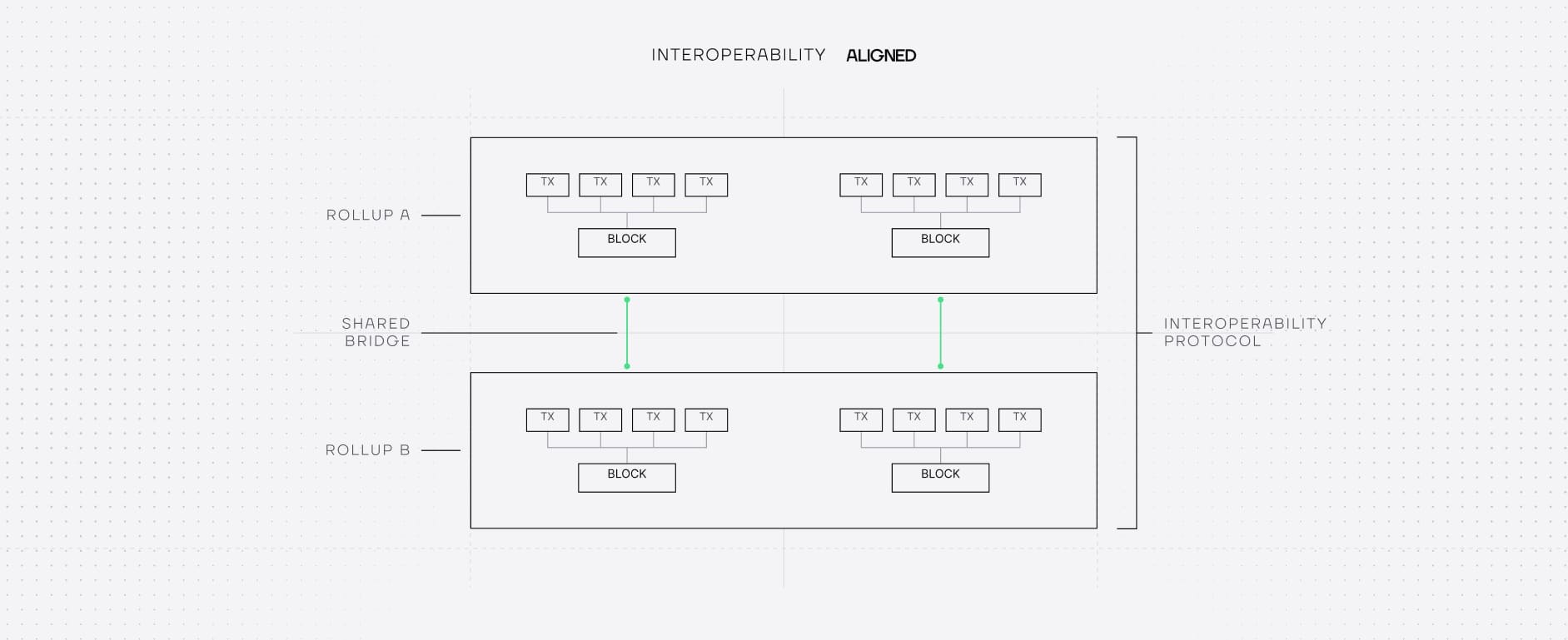
A dedicated chain is only an advantage if it can still reach the assets your users already hold, and most of those live on Ethereum. Aligned's Interoperability keeps that reach intact: Aligned-powered chains move value between each other through a native bridge with no third-party dependencies, and connect to Ethereum through standard L1 bridging. You get a chain built around your product without giving up the stablecoins and DeFi liquidity already on Ethereum.
Lambda VM
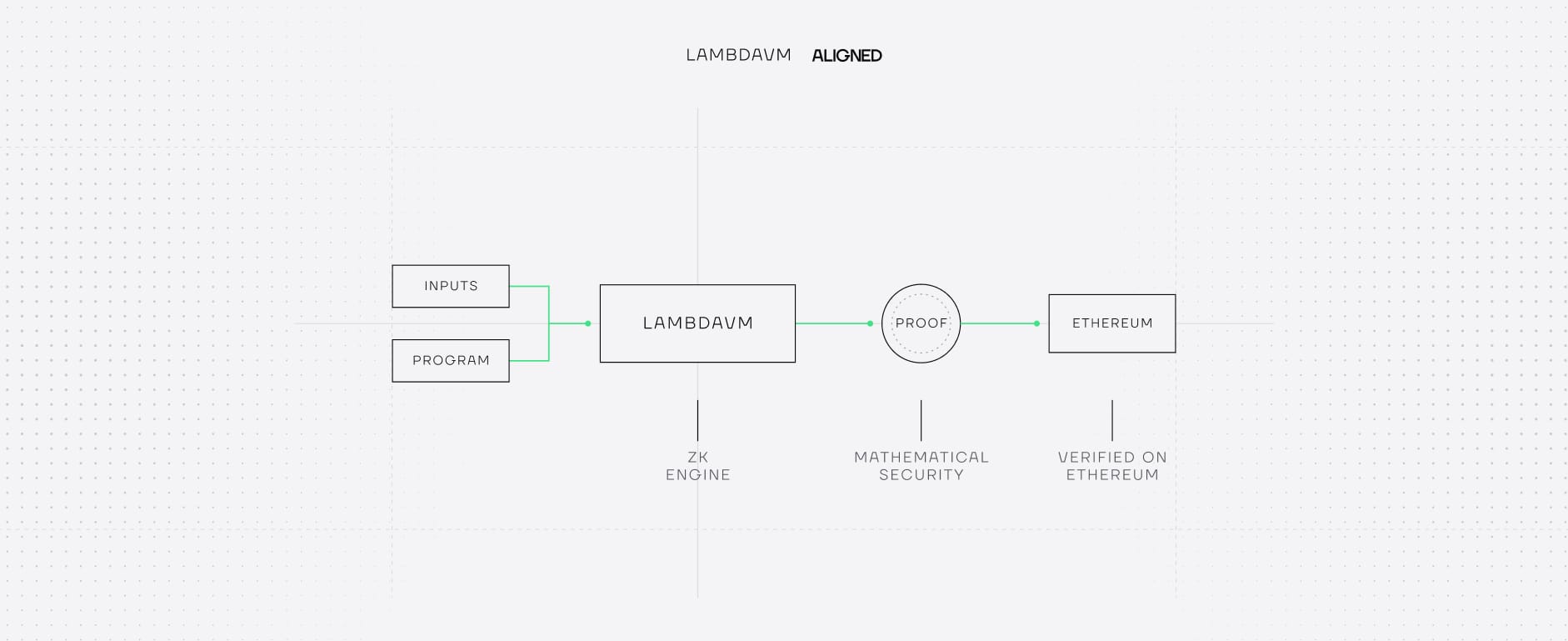
Lambda VM is Aligned's zkVM, and it exists because we don't think proving on Ethereum should depend on any single virtual machine. It's a RISC-V virtual machine built with LambdaClass and 3MI Labs, designed around post-quantum cryptography. It is under active development and not yet meant for production use. Our rollup stack already reflects that conviction: ethrex L2 proves with the SP1 zkVM and with trusted execution environments in production, with ZisK and OpenVM integrations underway. Lambda VM brings the design philosophy behind ethrex (simple, with minimal dependencies) to the proving engine itself. Once it's production ready, ethrex will add support for Lambda VM.
How does Aligned work?
Aligned builds its rollup stack on ethrex, the Rust Ethereum client from LambdaClass. ethrex operates in two modes: ethrex L1, a streamlined Ethereum execution client, and ethrex L2, a ZK-rollup client supporting multiple proving systems.
The same codebase that runs an Ethereum mainnet node runs the rollups we launch, which means consistent behavior between Ethereum and the rollup, and easier debugging.
ethrex is about 62,000 lines of Rust, where other clients take half a million. Small teams can audit and extend a codebase that size quickly, and that minimalism is the reason we chose it for our ZK rollups. ethrex also supports new Ethereum features like EIP-7702. Running it on mainnet gives Ethereum another independent execution client, and a more diverse client set makes the network itself more resilient.
The products build on each other: the wallet signs on Ethereum L1 and on the L2 rollups built with ethrex, those rollups settle through the Proof Aggregation Service, and the native bridge connects the chains we launch.
Each product also strengthens Ethereum itself. Proof aggregation makes verification affordable enough to settle there, ethrex deepens the client set, and based sequencing, once Aligned supports it, will hand transaction ordering back to Ethereum L1. Every one of those choices serves the same idea: a future where trust is not assumed, but proven by design.
Why use Aligned?
Teams come to Aligned with a specific product in mind, could be a remittance corridor, a neobank, a stablecoin-based payment rail, a digital identity system. All of them need to run cheaply at scale and to reach liquidity beyond a single chain. One integration replaces 10+ vendors. An Aligned chain ships with its wallet, proof aggregation, and bridging already fitted, and one team answers for all of it.
Aligned's first Rollup-as-a-Service partner, and an early Wallet-as-a-Service partner, is Sovra, a government digital-identity network. It runs identity for 6M+ people in Argentina, Mexico, and Colombia, across 20+ government deployments. Government identity is a demanding first workload, with uptime, cost, and data handling all under public scrutiny, and Sovra runs it in production today.
The trade-off is concentration, and that one team is us. We narrow it by keeping the entire stack open source, so anyone can read, fork, or run the code.
Aligned started with the most expensive problem, verifying proofs on Ethereum, which is the job the Proof Aggregation Service does today. The wallet, rollup, and interoperability products came after, each closing more of the gap between what Ethereum guarantees and what a financial product needs to run.
The engineers behind the stack have built this kind of infrastructure before: they come from LambdaClass, which made core contributions to Starknet, zkSync, and Polygon Miden and built ethrex and Lambdaworks, its open-source cryptography library. Founding partners get dedicated engineering support from that same team.
Aligned makes Ethereum inevitable for finance
The world's financial infrastructure is being rebuilt, and we think it should settle on the most credibly neutral foundation that exists. Everything in Aligned's stack follows from that conviction: wallets that onboard people who have never held crypto, dedicated chains that inherit Ethereum's security, and proofs that make verification affordable at scale.
Ethereum becomes inevitable when building on it is the easy choice. That's what Aligned offers. Everything it takes to run a financial product on Ethereum, from a user's first sign-in to final settlement, through a single integration.
Explore our developer docs