Aligned in Action: How Sovra Brings Verifiable Digital Identity to 8M+ Citizens
Verifiable credentials let one institution check a fact once and every later verifier rely on it. Sovra's platform puts them within reach of more than 8 million citizens across Latin America, built with Aligned and settled on Ethereum. Propia generalizes it into an open protocol.
Summary
Sovra's verifiable digital identity platform reaches more than 8 million citizens across Latin America, and it is built with Aligned. SovraChain settles on Ethereum through Aligned's Rollup-as-a-Service, and SovraWallet is built on Aligned's Wallet-as-a-Service. Propia is the generalized version of SovraChain: an open protocol that keeps issuer authority, key control, and credential status independently verifiable, while personal data stays with the holder.
Key facts
- Every institution re-verifies the same people from scratch, and reusable credentials remove that costly, fraud-prone duplication.
- Aligned provides the full stack as one integration: Rollup-as-a-Service, Wallet-as-a-Service, and Proof Aggregation Service, all settling on Ethereum.
- Sovra built SovraChain and SovraWallet on the stack, and keeps control of the product while Aligned runs the infrastructure.
- Sovra's platform reaches more than 8 million citizens. It is live in Argentina and Mexico and in development in Bogotá, Colombia, with more than 20 governments and public institutions on it.
- Propia, a public protocol Sovra built with LambdaClass and Aligned, lets any institution verify a credential with no central operator.
What a national digital identity has to do that most systems can't
A government credential is only useful if anyone asked to accept it can verify it independently. Today a bank, an employer, or a university can usually confirm someone's diploma or national ID only by going back to the issuer, so they all re-verify the same person and keep their own copies of the data. A signature on the document is not enough, and now that generative AI makes a convincing forgery cheap, looking authentic counts for even less.
A reusable credential fixes that. One institution verifies a fact once, and every later verifier can rely on that check. At national scale, the infrastructure behind reusable credentials needs a public record of who may issue them, along with a way to revoke them, rotate keys, and recover accounts. It also has to keep personal data private and hold costs down across millions of wallets.
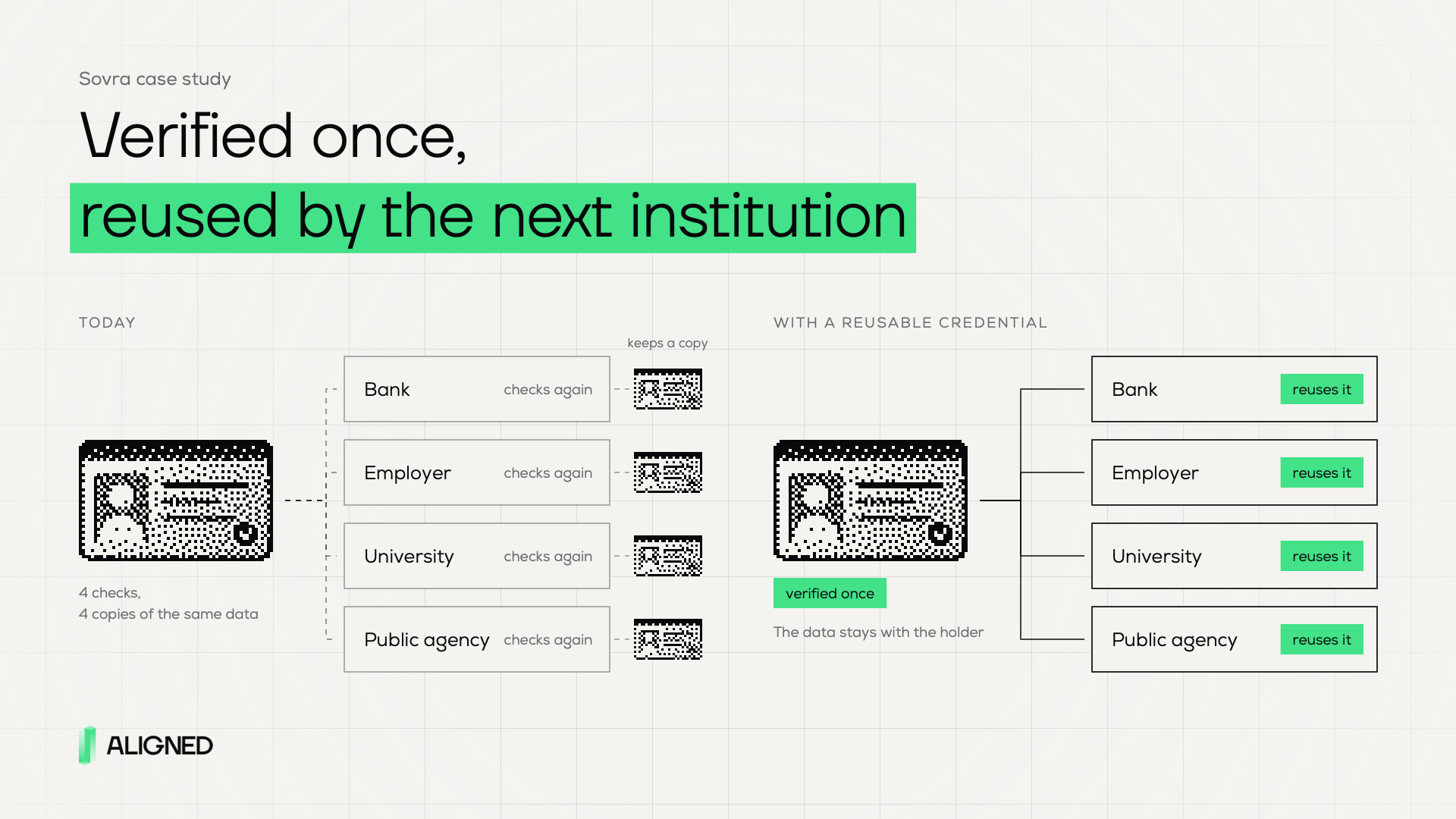
Few systems do all of this, and fewer still let any institution verify a credential on its own. This is the problem Sovra was built to solve. Sovra's platform now reaches more than 8 million citizens across Latin America, and it is built with Aligned.
What Aligned provides
A national identity system needs more than an app. It needs wallets for millions of citizens, a chain to anchor credentials, and a proving and settlement pipeline to make them verifiable. Each of those is normally a separate vendor and a separate operational burden. Aligned provides all of it as one integrated stack that settles on Ethereum:
- Rollup-as-a-Service: one-click ZK-rollups that settle on Ethereum, built with ethrex, the Rust Ethereum execution client from LambdaClass.
- Wallet-as-a-Service: embedded wallets built on EIP-7702 smart accounts, created from a familiar sign-in with no seed phrase.
- Proof Aggregation Service: live on Ethereum mainnet alpha, it lets many proofs share a single verification on Ethereum.
SovraChain and SovraWallet are built on the first two. Migrating SovraChain onto proof aggregation is active work.
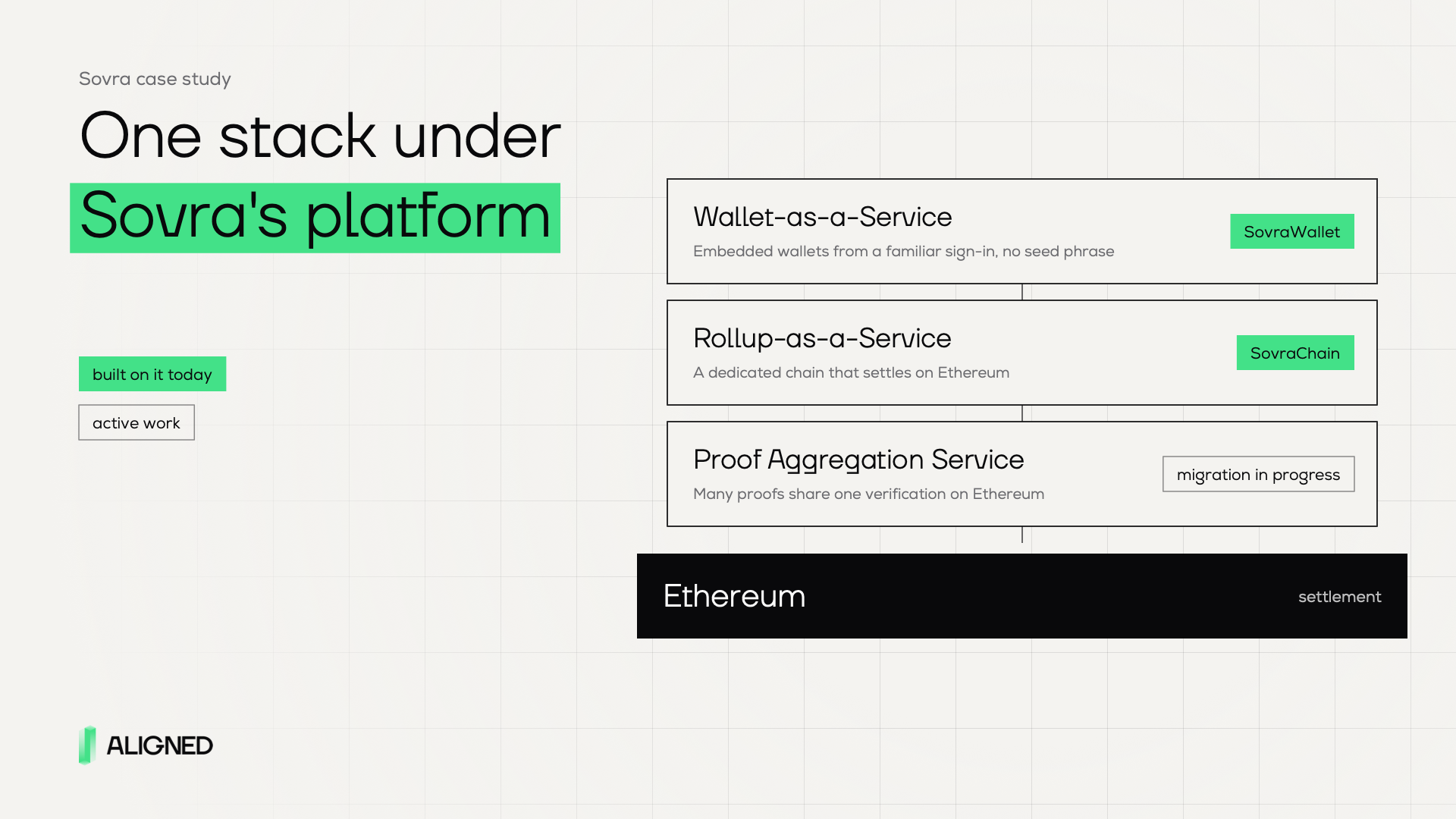
That lets Sovra's team build and control the identity product itself. Aligned deploys and maintains the rollup, proving, and settlement infrastructure underneath, so a focused team can run a national-scale service without standing up and operating the stack on its own.
What Sovra achieved
| 8M+ | 3 | 20+ | 75+ |
| citizens reached | countries | governments and public institutions | implementations |
Sovra's platform puts government credentials on citizens' phones, and through Propia, institutions that have never dealt with the issuer can check them. The platform does that by serving two groups at once. Citizens need to use credentials with no knowledge of blockchains, and governments need to keep control of what they issue. Sovra built one product for each, both on Aligned's stack.
On the citizen side, SovraWallet is built on Aligned's Wallet-as-a-Service. Citizens authorize actions with a passkey held on their own device, so there is no seed phrase to manage. Sponsored transactions mean they do not need to buy a token to use a government service, and because each credential is tied to a stable identifier, it survives an authorized key change.
On the government side, Sovra runs SovraChain, the chain that holds the public registries where each government records who may issue its credentials. Sovra was the first user of Aligned's Rollup-as-a-Service, and SovraChain runs on that service as a validium, meaning its state commitments settle on Ethereum while the underlying data stays offchain. The chain is on mainnet, with a public explorer where anyone can follow its activity. Propia, a public trust layer for verifiable credentials, generalizes this design into an open protocol that any government or institution can adopt.
| What population-scale identity requires | How Sovra's stack handles it |
|---|---|
| Prove who may issue what, and revoke it | Public issuer and status registries, read directly without contacting the issuer |
| Key rotation and account recovery | Identifier registry records which keys control an identifier, so rotation and recovery are governed, recorded changes |
| Custody citizens can operate | Passkeys on the citizen's device, no seed phrase, sponsored transactions |
| Hold cost steady at millions of wallets | Validium batching keeps data offchain |
| Verification no single party controls | State commitments settled and verified on Ethereum |
In production across Latin America
Sovra's most detailed published results come from Nuevo León, Mexico, where the state government launched its NLínea digital wallet with Sovra. NLínea puts state-issued credentials and biometric sign-in on citizens' phones. The NLínea catalog lists 744 procedures and services, and more than 300 of them are fully digital. According to the Government of Nuevo León, digitization has cut requirements by up to 30% and response times by up to 80%, and the OECD recognized the state as one of five international best practices in digital service windows.
In Argentina, Sovra's platform is live in Salta, where IDDI, the provincial digital identity platform, has issued verifiable documents since 2023 and more than 60 government services run on it. In Luján de Cuyo, Mendoza, the municipal digital window went live in under six months. In its first year it registered 25,000 residents (15% of the population), completed 16,000 procedures, and digitized more than 60 services, according to Sovra.
The platform is in development in Bogotá, Colombia. There, the city's SuperApp, which brings together 62 entities and more than 1,400 procedures, is building its credential layer on Propia and SovraWallet, in a program financed by CAF, the Development Bank of Latin America and the Caribbean, and coordinated through the Consejería Distrital de TIC. At a verifiable credentials bootcamp in Bogotá, more than 40 public-sector developers built working pilots in under 48 hours.
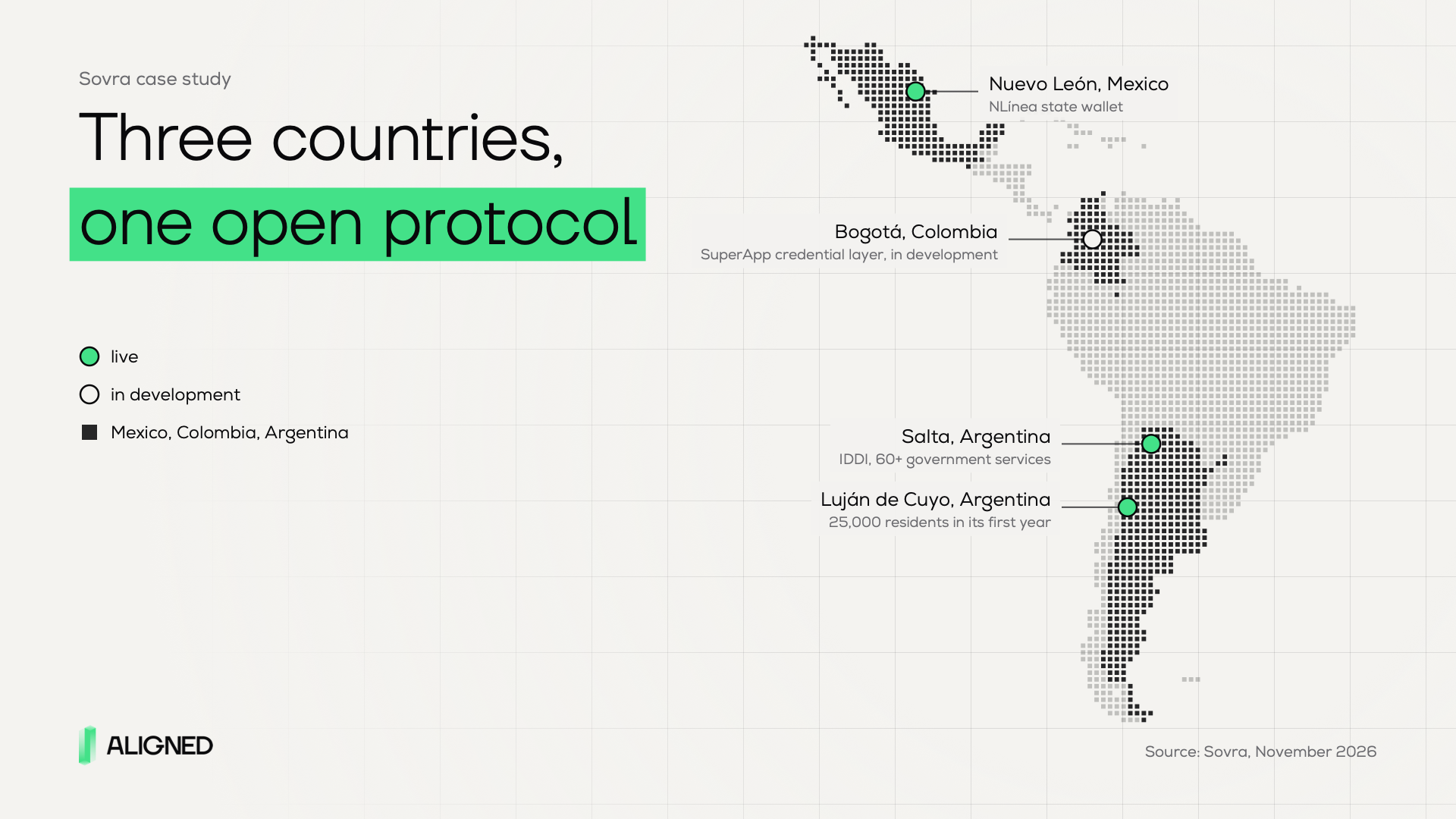
Under Propia, each participating government keeps its own authority over issuance, yet its credentials can still be checked across borders. A verifier in Mexico City can check a NLínea credential with the same software that checks a Bogotá SuperApp credential.
A shared database could offer the same convenience, but one operator would control it and could rewrite its history. Every participating institution would then have to trust that operator not to do so. In Sovra's deployments, Propia's registries run on SovraChain, a validium Sovra operates through Aligned's Rollup-as-a-Service. Their state commitments settle on Ethereum, so no single operator, Sovra included, can rewrite the registry history once it is final.
How Propia enables institutions to trust each other's credentials
Propia is a public trust layer for verifiable digital credentials, developed by Sovra together with LambdaClass and Aligned so that institutions can trust credentials they did not issue. It takes what SovraChain does in Sovra's deployments and generalizes it. NLínea and Bogotá's SuperApp both build on it. Sovra, LambdaClass, and Aligned co-authored the Propia whitepaper, which lays out the protocol's design and its commitments to open verification and institutional exit rights.
In practice, a citizen's wallet holds the credential itself, while three public registries record only what a verifier needs to check it. The issuer registry records who may issue what, scoped so that a transport authority can be cleared for driver's licenses but not university degrees. The identifier registry tracks which keys control each identifier, and the status registry lists which credentials have been suspended or revoked.
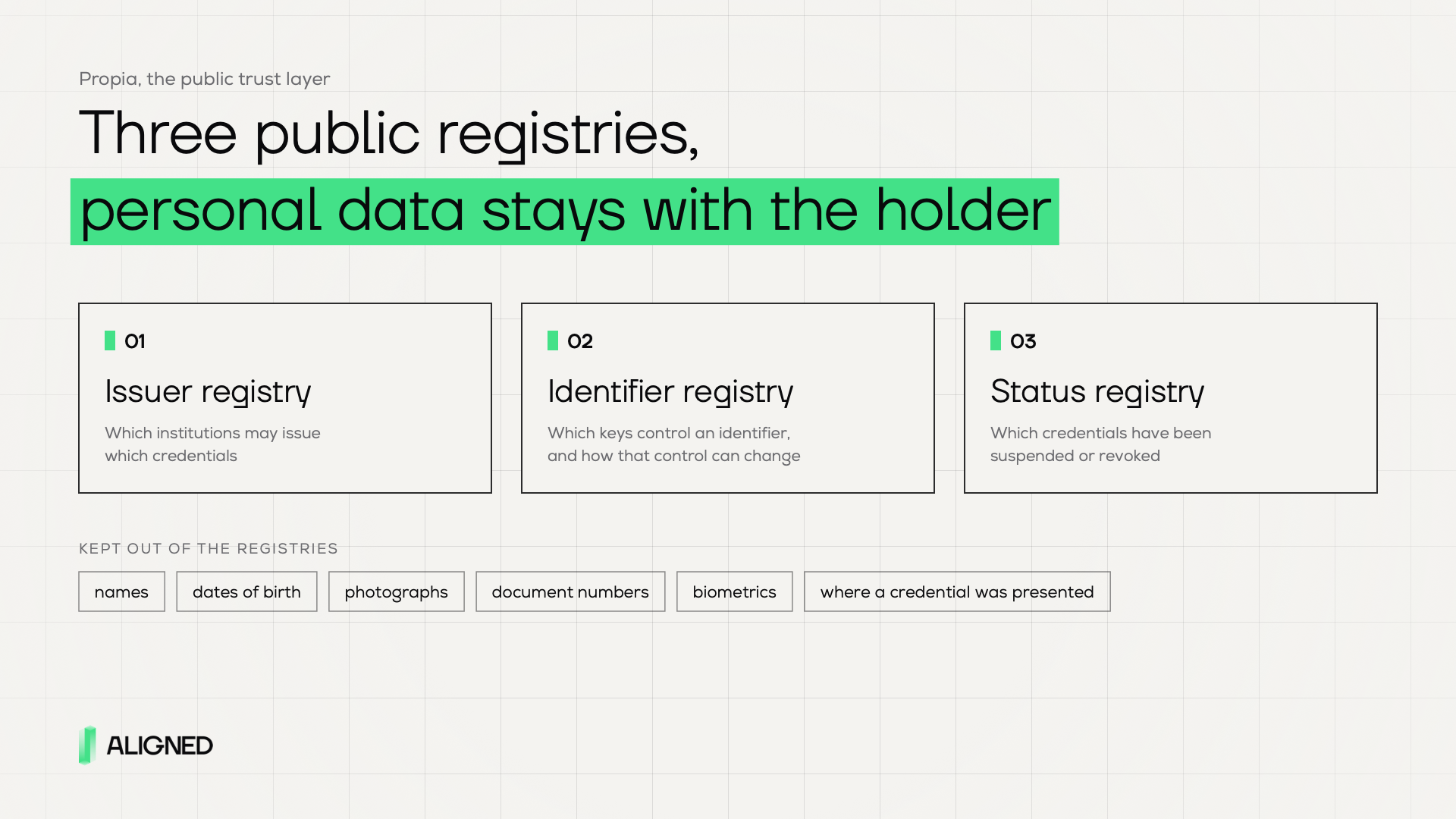
When banks, universities, or other institutions receive a verifiable digital credential, they run five checks: integrity, issuer authority, holder binding, temporal validity, and status. Because credential payloads, names, dates of birth, and biometrics never enter the registries, Propia is not a universal identity database. Checking a credential against the public registries reveals nothing beyond what the citizen presents.
New wallets, verification services, and applications can join without anyone's approval, because Propia's specifications and core contracts are open for independent implementation. It follows open standards, including the W3C Verifiable Credentials and DID Core data models, SD-JWT VC and ISO mdoc credential formats, OpenID4VCI and OpenID4VP for issuance and presentation, and the Bitstring Status List for revocation.
- Open verification, with no private agreement: Because the registries are public, verifiers need no contract with the issuer and never have to call it. They can still check a credential while the issuer's service is down, and the issuer never learns where or when a citizen presents it. Any participant can verify the finalized commitments through its own Ethereum node.
- Exit rights for institutions: Institutions that issue credentials get the same independence. They can change vendors and keep already-issued credentials working, because no issuer, government, or infrastructure provider, including Aligned, controls settlement. Governments need that guarantee, since the system is meant to outlive both its vendors and the administrations that launch it.
- Millions of wallets at a low cost per operation: Across a national population, issuers update credential status and citizens rotate keys or recover accounts continuously. SovraChain keeps the data for those updates off Ethereum and settles only state commitments there. Because SovraChain does not publish that data to Ethereum, it carries more throughput at a lower marginal cost than a rollup that does.
Ethereum accepts a state commitment only after verifying its proof, but the proof cannot show whether an institution's decision was right or identity proofing was done correctly. Within that scope, the check blocks any change that adds an unauthorized issuer, alters a credential's status without authority, or replaces an identifier's controller outside policy. Each Propia deployment must keep its offchain data available, since a lapse could stop verifiers from rebuilding the current state but cannot make an invalid change pass.
Verifiable institutional trust at country scale
Sovra built its digital identity platform on Aligned's stack and kept full control of the product. That platform is now accessible to more than 8 million citizens and more than 20 governments and public institutions across Latin America.
Propia extends Sovra's work beyond any single government. Bogotá's SuperApp is building its credential layer on it now, and because the protocol is open, new wallets, verification services, and applications can join without anyone's approval. Each issuer and verifier that joins widens the reach of every credential in a region of 650 million people, and beyond.