
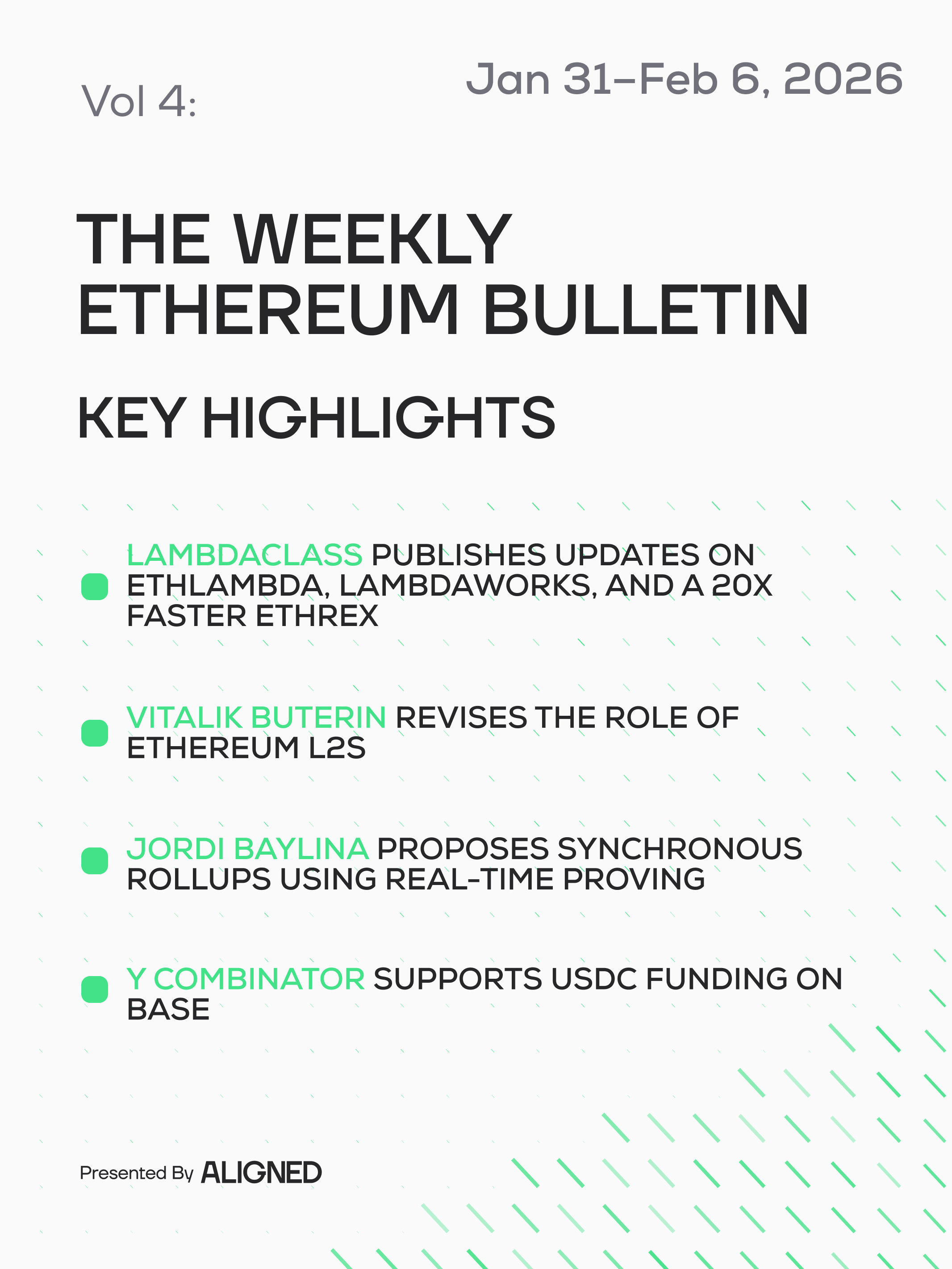
The Weekly Ethereum Bulletin! Vol. 4: January 31–February 6, 2026

Key highlights:
- LambdaClass publishes updates on Ethlambda, Lambdaworks, and a 20x faster Ethrex
- Vitalik Buterin Revises the Role of Ethereum L2s
- Jordi Baylina Proposes Synchronous Rollups Using Real-Time Proving
- Y Combinator Supports USDC Funding on Base
LambdaClass Shares Update on EthLambda and Post-Quantum Lean Consensus
LambdaClass published a follow-up article on EthLambda, explaining how the post-quantum Lean Consensus client is developed using shared ecosystem tooling.
The post covers:
- EthLambda's participation in pq-devnet-2, focused on leanMultisig signature aggregation
- The specifications, cryptographic primitives, and developer tooling that support these efforts
- The core challenge: XMSS post-quantum signatures are 3,112 bytes vs. 96 for BLS, making aggregation essential. The devnet targets 400 validators based on ~400 XMSS aggregations per second.
New @ethlambda_lean post!
— LambdaClass (@class_lambda) February 6, 2026
Building a post-quantum Ethereum client with the help of shared tooling: what a Lean Consensus client consists of and what tooling facilitates its development. pic.twitter.com/bfQEUWarlb
LambdaClass Updates Lambdaworks Roadmap and Priorities for 2026
LambdaClass shared an updated 2026 roadmap for lambdaworks, its Rust-based cryptographic and zero-knowledge library with over 575 merged PRs from nearly 80 contributors.
The update outlines plans to:
- Expand STARK and Plonk support
- Add new polynomial commitment schemes and post-quantum signatures
- Improve GPU acceleration and performance
- Strengthen code quality
The roadmap positions lambdaworks as core infrastructure for projects like ethrex, ethlambda, zkVMs, and high-throughput L1 and L2 systems.
Check the roadmap for 2026 for @class_lambda lambdaworks. In the coming weeks we will be adding more functionality and improving performance. Link below pic.twitter.com/NLMw20m115
— Diego Kingston🟩 (@diego_aligned) February 3, 2026
LambdaClass Details How Ethrex Achieved a 20x Performance Gain
LambdaClass published a deep dive into the performance engineering work behind ethrex, explaining how systematic profiling, architectural changes, and targeted optimizations led to a 20x improvement in block execution throughput: from 20 MGas/s to 400 MGas/s.
The article covers:
- EVM execution optimizations: memory model redesign, opcode lookup tables, and inlined common opcodes
- Faster hashing with assembly-optimized SHA3/Keccak and a switch to fxhash for internal operations
- Storage: Deferred hash computation cut trie insertion time nearly in half
- Parallel merkleization: 16-way parallel processing across CPU cores
- Pipelined block processing and execution-based cache prewarming
First day @ethrex_client is the fastest execution @ethereum client in our servers.
— Fede’s intern 🥊 (@fede_intern) February 4, 2026
Congrats @class_lambda. 0.713 Gigagas per second on average the last 24 hours! pic.twitter.com/hufOyfAoqr
Vitalik Revises the Role of Ethereum L2s
Vitalik Buterin said the original idea of L2s as "Ethereum-branded shards" no longer fits, citing slower L2 decentralization and faster Ethereum L1 scaling.
His updated view:
- L2s should be seen as a spectrum of Ethereum-backed chains
- Focus on value beyond scaling: privacy, specialized VMs, and extreme throughput
- L2s working with ETH should be at least Stage 1
- Maintain strong interoperability with Ethereum
There have recently been some discussions on the ongoing role of L2s in the Ethereum ecosystem, especially in the face of two facts:
— vitalik.eth (@VitalikButerin) February 3, 2026
* L2s' progress to stage 2 (and, secondarily, on interop) has been far slower and more difficult than originally expected
* L1 itself is scaling,…
Jordi Baylina Proposes Synchronous Rollups Using Real-Time Proving
Jordi Baylina published a research post outlining how real-time proving, combined with proxy contracts and execution tables, could enable synchronous composability between rollups.
The proposal:
- Allows atomic cross-chain contract calls that succeed or revert within a single transaction
- Avoids any L1 forks
- Removes the delays and loss of atomicity seen in asynchronous cross-chain designs
Just posted a new proposal on EthResearch about synchronous composability between rollups via realtime proving.
— Jordi Baylina - baylina.eth (@jbaylina) February 2, 2026
The idea explores how based rollups with realtime validity proofs could enable atomic L1↔L2 and L2↔L2 interactions in a single transaction, bringing back true…
Y Combinator Supports USDC Funding on Base
Y Combinator announced it is offering startup funding in USDC on Base.
Key points:
- Highlights stablecoins' low cost, efficiency, and global reach
- The passage of the GENIUS Act as a key driver
- Expects startups, whether crypto-focused or not, to use crypto-enabled systems for payments, banking, and capital raising
Today, Y Combinator is announcing that YC-funded startups can choose to receive their funding ($500k) in stablecoins.
— Y Combinator (@ycombinator) February 3, 2026
We believe stablecoins like @usdc are setting the stage for a new fintech renaissance and broader global access to financial services. Sending money should be as…
Stay tuned: 🐦 Twitter | 💬 Telegram | 👾 Discord | 🌐 Website | 📺 Youtube | 📝 Manifesto